How to Choose the Best Unmanaged Ethernet Switch for Your Needs?
Choosing the best unmanaged ethernet switch can significantly impact your network's performance. An unmanaged ethernet switch is simple and cost-effective, making it ideal for small offices or home networks. However, understanding your specific needs is crucial before making a decision.
Many options are available, and they all serve different purposes. Do you need more ports or faster speeds? The right switch can improve data transmission and enhance device connectivity. The challenge lies in balancing features with your requirements.
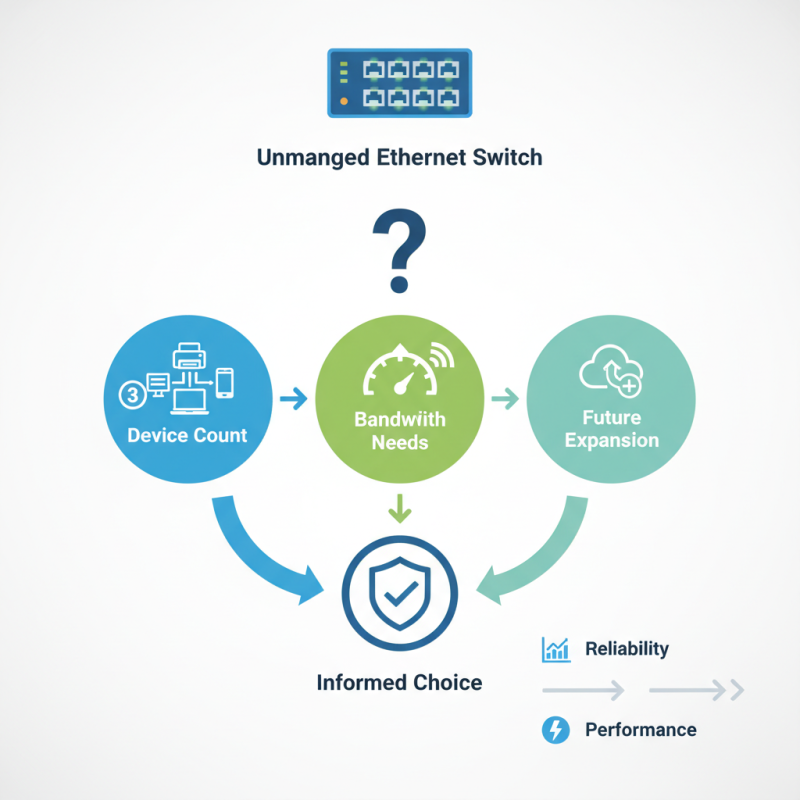
Expertly evaluating your environment can lead to a more informed choice. Consider factors like device count, bandwidth needs, and future expansion. While it’s easy to be overwhelmed by options, reflecting on your actual needs will guide you to the right unmanaged ethernet switch. Investing time in this decision pays off in better reliability and performance.
Understanding Unmanaged Ethernet Switches and Their Functions
Unmanaged Ethernet switches are essential in network setups. They enable devices to communicate without complex configurations. These switches operate seamlessly, making them user-friendly, especially for small businesses. About 76% of businesses are opting for unmanaged switches due to their simplicity.
Understanding their functions is crucial. An unmanaged switch allows data packets to flow between devices on a LAN. They typically come with a fixed number of ports, which are often 5, 8, or 16. Detailed studies show that small networks benefit significantly from these devices. They reduce latency and can improve overall network performance. However, users must remember that unmanaged switches lack advanced features like VLAN support or extensive network management tools.
Selecting the right switch requires assessing your specific needs. Consider the number of devices you intend to connect. Also, the switch’s speed is important—most unmanaged switches operate at 1 Gbps. However, some older models may only support 100 Mbps. This disparity can impact the network's efficiency. Those who fail to evaluate these aspects may face connectivity issues. An informed choice often leads to smoother operation and less frustration.
Key Factors to Consider When Selecting an Unmanaged Ethernet Switch
When selecting an unmanaged Ethernet switch, several key factors must be considered. The number of ports is essential. Most switches come with 5, 8, or 16 ports. For small businesses, a switch with at least 8 ports is often sufficient. However, larger setups may require 24 or more ports. Not all switches handle data traffic equally. An unmanaged switch may not support high bandwidth, affecting network performance. According to a recent industry report, over 80% of businesses experience network slowdowns due to insufficient switching capacity.
When assessing the switch’s speed, look for those that support gigabit Ethernet. This feature ensures faster data transfer, crucial for data-intensive applications. Additionally, consider the switch's form factor. Rack-mounted switches optimize space in server rooms. Desktop models, on the other hand, fit well in smaller workspaces. However, their limited capability may not be ideal for growing networks.
Tip: Always evaluate the future growth of your network before purchasing. If you project significant expansion, choosing a switch with more ports and higher capacity may save money later. Remember, the total power consumption of switches can impact your energy bills. Select models designed for energy efficiency to reduce costs long-term. A little foresight can prevent potential pitfalls.
Assessing Port Count and Speed Requirements for Your Network
When selecting an unmanaged Ethernet switch, understanding your port count and speed requirements is crucial. A report from the IEEE indicates that the market for Ethernet switches is expected to grow significantly, driven by increasing demand for high-speed connectivity. It is essential to assess both current needs and future scalability. For instance, a small office may only require 5-8 ports initially, while a growing business might soon need 24 ports or more.
Speed is another vital factor. Today, many switches offer 1 Gbps as a standard, which suits most applications. However, if your network demands more bandwidth, consider switches that support 10 Gbps or higher. According to a survey by Data Center Knowledge, as networks evolve, 40% of businesses report they have outgrown their existing switch capabilities within two years. This data emphasizes the need for forward-thinking when choosing your switch.
It’s also important to reflect on the environment. A switch might perform perfectly in a controlled setting but fail under physical stress or temperature fluctuations. Often, users overlook the importance of cooling and placement, leading to potential failures. Balancing cost, capacity, and performance requires careful consideration.
Evaluating Power Consumption and Size of the Unmanaged Switch
When selecting an unmanaged Ethernet switch, evaluating its power consumption and size can significantly affect overall operational efficiency. According to a report by the International Energy Agency (IEA), the typical power consumption of network switches ranges from 3 to 40 watts. This variance emphasizes the importance of assessing your needs before purchasing. An efficient switch can save costs in the long run.
Size also plays a crucial role in switch selection. Many unmanaged switches come in desktop sizes, while others are rack-mounted. Choosing a compact model may seem convenient, but it often sacrifices port density or performance. A switch that fits well into your network design may require further evaluation of specifications. This consideration often gets overlooked, leading to potential scalability issues in the future.
Think about the placement and the amount of heat generated. Poor ventilation can lead to reduced performance over time. According to the Environmental Protection Agency (EPA), maintaining optimal temperature is crucial for electronic devices. Thus, carefully examining power rating and physical dimensions will yield a suitable choice for your specific environment.
How to Choose the Best Unmanaged Ethernet Switch for Your Needs? - Evaluating Power Consumption and Size of the Unmanaged Switch
| Model | Ports | Power Consumption (W) | Size (L x W x H, cm) | Weight (kg) |
| Switch A | 5 | 7 | 20 x 10 x 3 | 1.2 |
| Switch B | 8 | 10 | 30 x 15 x 5 | 2.5 |
| Switch C | 16 | 15 | 40 x 20 x 4 | 3.8 |
| Switch D | 24 | 20 | 50 x 25 x 6 | 4.5 |
Comparing Cost and Brand Reputation in Unmanaged Ethernet Switches
When choosing an unmanaged Ethernet switch, evaluating cost and brand reputation is crucial. Cost directly impacts your budget, but it shouldn’t be the only factor. Some low-cost switches may lack essential features or reliability. Weigh the upfront price against potential long-term costs. A reliable switch may save you money through reduced downtime and maintenance.
Brand reputation also plays a significant role. Established brands typically provide quality products. They often have a history of performance and dependability. However, newer brands might offer innovative features at competitive prices. It's essential to research customer reviews and expert opinions to gauge reliability. Pay attention to customer service experiences as well. Good support can make a difference when you face technical issues.
While cost and reputation are key, remember that no switch is perfect. Some users report issues with specific models, even from reputable brands. It's wise to consider other factors like speed and the number of ports. Reflecting on your specific needs will guide you to the best choice. Balancing cost with brand reputation requires careful thought and research.