
7 Carbon Fiber Card Buying Tips for Global Buyers
Buying a Carbon Fiber Card for an international project can seem straightforward. It rarely is. A glossy black surface may look convincing in a photo, yet appearance alone cannot confirm the material or construction. Buyers should clarify whether the card uses actual carbon-fiber sheet, a composite layer, or a printed pattern. Small details matter.
The right choice depends on the card’s purpose, expected handling, and production requirements. Ask suppliers for dimensions, thickness tolerance, edge finish, surface options, and material details in writing. Request a physical sample when possible. Hold it under ordinary light. Check the edges, feel, and legibility of any printed or engraved information. A sample can reveal issues that product images hide, though one sample cannot guarantee every production batch. I would not treat a neat sample as a promise.
Global purchasing adds practical questions. Confirm minimum order quantities, customization limits, packaging, production timelines, and shipping terms before approving a design. Share artwork in a clear, agreed format, and ask how color or finish differences are handled between samples and bulk orders. Keep written records of specifications and approvals. They help both sides.
These seven buying tips are designed to help international buyers compare offers with greater confidence, not chase the lowest quote alone. Price matters, of course. So do consistency, communication, and realistic lead times. No checklist removes every risk. A careful review can still prevent avoidable surprises and help you select a Carbon Fiber Card suited to its actual use.
Understanding Carbon Fiber Cards and Their Common Uses
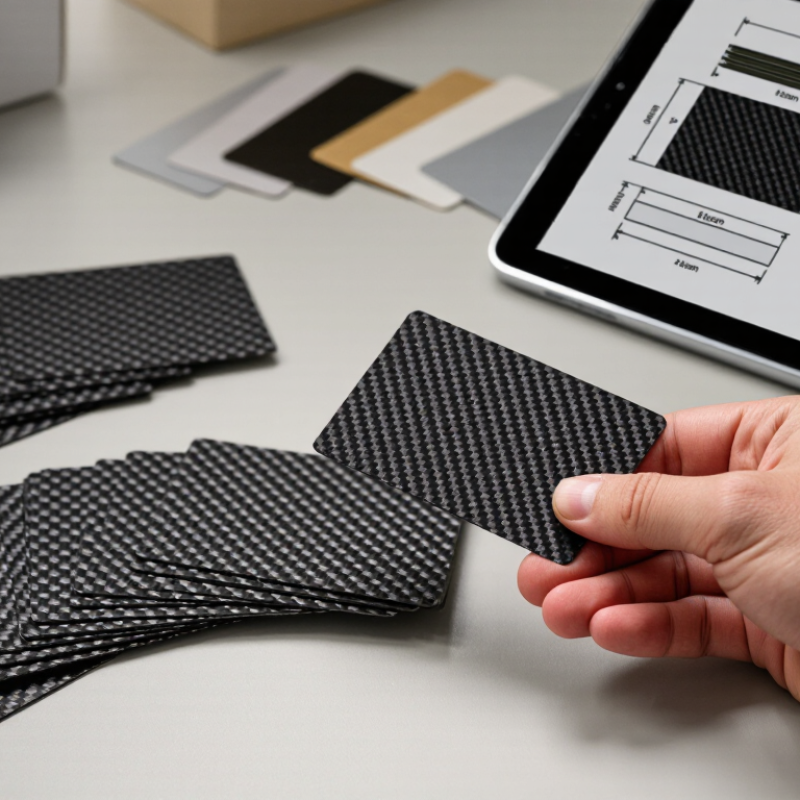
Carbon fiber cards are thin cards made with carbon-fiber material, often bonded to a resin or another backing. The visible weave may look similar across products, but thickness, finish, and edge quality can differ. Some cards use carbon fiber only as a surface layer, so ask suppliers what the card contains. A cool, textured surface feels distinctive, but appearance alone does not prove durability.
Common uses include premium business cards, membership cards, gift cards, and custom presentation pieces. They suit situations where a rigid feel and unusual finish matter. They are not ideal for every reader or printer. Carbon fiber can affect radio signals, so cards designed for access or contactless use need compatibility testing. One detail is easy to overlook.
Tip: Request a sample and check its weight, corners, and surface under ordinary handling. If the card needs NFC or RFID, test it with the intended reader before placing a large order. Ask about print methods, artwork limits, and care instructions. A glossy finish may show fingerprints; a matte one can make fine details less clear. The best choice depends on how people will actually use the card, not just how it looks in a product photo.
7 Carbon Fiber Card Buying Tips for Global Buyers - Understanding Carbon Fiber Cards and Their Common Uses
| Buying tip | What to check | Useful facts and guidance | Common use |
|---|---|---|---|
| 1. Confirm the card’s construction | Ask whether the card is made from carbon-fiber composite, a carbon-fiber surface layer bonded to a core, or a printed carbon-fiber pattern. | These constructions can differ in appearance, rigidity, edge finish, and cost. Request a physical sample and a written material description before approving a large order. | Premium business cards, presentation cards, and branded membership cards. |
| 2. Match dimensions to the intended format | Specify finished length, width, thickness, corner radius, and dimensional tolerances. | ISO/IEC 7810 ID-1 format measures 85.60 × 53.98 mm, with a nominal thickness of 0.76 mm. This is a common payment and identification-card format, but custom cards may use other dimensions. | Wallet cards, access badges, and cards intended for standard ID-1 card holders. |
| 3. Check contactless and chip compatibility | If the card needs NFC, RFID, or a payment chip, confirm antenna placement, material openings or non-conductive windows, and testing on the finished card. | Carbon-fiber composites are electrically conductive and can affect radio-frequency performance. Compatibility depends on the full card construction, so a material claim alone does not confirm reliable contactless operation. | Contactless access, transit, membership, or payment cards. Payment cards also require the relevant issuer and payment-system approvals. |
| 4. Choose a suitable print and finish | Review how the design will be applied and check contrast, legibility, surface texture, and scratch resistance on a finished sample. | The woven appearance and dark tones of carbon-fiber surfaces can affect color reproduction and fine-detail visibility. Approve artwork against a production-representative proof. | Business cards, event credentials, gift cards, and premium loyalty cards. |
| 5. Evaluate durability for the actual environment | Ask about edge bonding, surface protection, flexing, abrasion, and exposure to moisture, heat, or chemicals relevant to the intended use. | Performance depends on the resin, core, laminate, and manufacturing quality—not just the presence of carbon fiber. Request documented test methods and results where durability is critical. | Frequently handled access cards, staff badges, and long-term membership cards. |
| 6. Confirm personalization and data-security needs | Specify whether each card needs a unique serial number, barcode, QR code, magnetic stripe, chip, or variable printed details. | Test codes and encoded features on final samples. For cards carrying personal or access data, define how artwork, card data, proofs, and production files will be handled and protected. | Employee ID, visitor access, loyalty programs, and controlled-entry credentials. |
| 7. Plan international shipping and compliance | Confirm packed dimensions and weight, lead time, sample approval, customs documentation, packaging, and any destination-market requirements. | Import duties, taxes, product rules, and delivery timelines vary by destination and shipment terms. Agree on the specifications, inspection criteria, and delivery responsibilities before production. | Bulk orders for international events, offices, clubs, and card programs. |
Identifying the Material Grade, Finish, and Manufacturing Quality
Start with the material. Some cards use carbon-fiber composite, while others only print a carbon-like pattern. Ask suppliers for the construction details, such as fiber layers, resin type, and overall thickness. A clear specification is more useful than a dramatic product photo. Color alone proves little. Check the edge. A real composite may reveal layered fibers along a cut edge, though coatings can hide them. Request a close-up sample and compare it with the stated material, rather than relying on the surface appearance.
Finish affects daily handling. Matte surfaces usually show fewer fingerprints, while glossy coatings can make weave patterns look sharper. I still find glossy samples attractive, but shine is not a quality test. Inspect corners for chips, uneven coating, or exposed fibers. Then check manufacturing consistency across several samples: compare thickness, card dimensions, print alignment, and edge smoothness. Small variations can matter when cards must fit a wallet or card reader. Ask how defects are inspected and whether production samples match the approved sample. A polished prototype is reassuring, but it does not guarantee every batch will be identical. Keep the agreed material grade, finish, and tolerances in writing.
Checking Card Dimensions, Thickness, and Compatibility
A card can look standard and still fail at the slot. ISO/IEC 7810:2019 defines the ID-1 format as 85.60 × 53.98 mm, with a nominal thickness of 0.76 mm and a stated tolerance. Measure the finished card, not only its design file. Measure twice. Rounded corners, laminate, and surface coatings can affect fit in wallets, readers, and printers.
Thickness matters most where cards pass through tight mechanisms. Check the full build, including any embedded chip, adhesive layers, and protective finish. Ask the supplier for measured samples and tolerances, then test them in the actual reader or printer. A digital drawing is useful, but it cannot reveal a raised edge or a slightly bowed card. That gap is easy to overlook.
Compatibility needs a separate check. For contactless cards, ISO/IEC 14443-2 specifies the radio-frequency interface used by proximity cards, including operation at 13.56 MHz. Carbon fiber is electrically conductive, so its placement around an antenna may affect communication. Ask for the antenna layout and test read performance through the final card construction. Do not assume a successful chip test guarantees contactless performance; I would verify both, even if that adds a small delay.
7 Carbon Fiber Card Buying Tips for Global Buyers: Check Dimensions, Thickness, and Compatibility
How to use this chart: For a standard bank-card footprint, look for the ID-1 format: 85.60 × 53.98 mm, with a nominal thickness of 0.76 mm. Confirm the finished card’s measurements and tolerances with the supplier, especially if it must fit a wallet, slot, or reader.
- Confirm the required card format and dimensions.
- Check the card’s actual thickness, including any coating or laminate.
- Verify fit with the intended wallet, holder, or card slot.
- Ask whether the carbon-fiber construction affects contactless or RFID performance.
- Check chip, magnetic-stripe, or other feature placement if needed.
- Request a physical sample when fit or performance is critical.
- Confirm the final specifications before approving production.
The chart shows nominal width and height for ISO/IEC 7810 card formats. Dimensions alone do not guarantee compatibility; thickness, construction, and reader requirements also matter.
Evaluating Suppliers, Pricing, and Minimum Order Requirements
When comparing carbon fiber card suppliers, ask what “carbon fiber” means in the quoted product: a real woven layer, a printed pattern, or a composite laminate. Request material specifications, thickness tolerances, surface-finish details, and a physical sample. Check whether the supplier can share inspection records and explain how defects are handled. Small details matter. A glossy sample may hide uneven edges.
Grand View Research estimated the global carbon fiber market at USD 6.3 billion in 2023 and projected an 11.0% annual growth rate from 2024 to 2030. This broad market figure is not a card-price benchmark. It does show why buyers should compare like with like: fiber grade, resin system, card construction, printing, packaging, and shipping can all change the quote. Ask suppliers to separate setup charges from unit prices and state quote validity. Otherwise, comparisons can be misleading.
Minimum order quantities often reflect setup work, tooling, and production efficiency, so they vary by supplier and design. Request prices at several order levels, plus the cost and lead time for a small pilot batch. Confirm whether custom dimensions or finishes raise the minimum. I would be cautious about choosing the lowest MOQ alone; a tiny run may carry a steep unit cost, while a large commitment is risky before sample approval. That trade-off deserves a second look.
Reviewing Certifications, Packaging, and International Shipping Terms
When comparing carbon fiber cards, ask for certificates that match the exact material, thickness, and intended use. Check the issuer, test date, and report number, then confirm the document covers the production batch being offered. A certificate alone is not proof that every shipment matches the tested sample. Request a batch record or inspection photos. Keep records.
Packaging deserves the same scrutiny. Ask how each card is separated, protected from surface scratches, and supported at the corners. For example, thin foam sheets and a rigid outer carton can reduce rubbing and bending during handling. If cards have a decorative finish, request photos of the packed goods, not just a sample card. Small details matter. I would still inspect the first delivery; packaging descriptions can sound better than the real carton.
Agree on shipping terms before paying. State the named place and the chosen Incoterms rule, such as DAP or FOB, rather than relying on “shipping included.” Confirm who arranges freight, insurance, export clearance, and import charges. Ask for the commercial invoice, packing list, tracking details, and realistic transit estimates. Customs classification can vary by product details and destination, so verify it with your broker or relevant customs authority. Delays happen. Build a little buffer into your schedule, even when the supplier’s estimate looks precise.