How to Choose the Best Cooling Tower for Your Needs?
Choosing the right cooling tower is crucial for efficiency and sustainability. According to the Energy Information Administration, industrial processes account for nearly a third of energy use in the United States. Cooling towers play a vital role in reducing this consumption. An appropriate cooling tower can lower energy costs by up to 20%.
Several factors influence the selection process. These include capacity, type, and the specific application of the cooling tower. The market offers a variety of designs, each with its own strengths and weaknesses. It’s important to evaluate these aspects thoroughly. Poor choices can lead to increased energy costs and operational inefficiencies.
Furthermore, environmental considerations cannot be overlooked. Cooling towers can impact overall water consumption levels. This connection between performance and ecological footprint is crucial in today’s context. Understanding the local climate and operational needs helps in making informed decisions. A cooling tower should align with your operational goals while mirroring environmental responsibility.
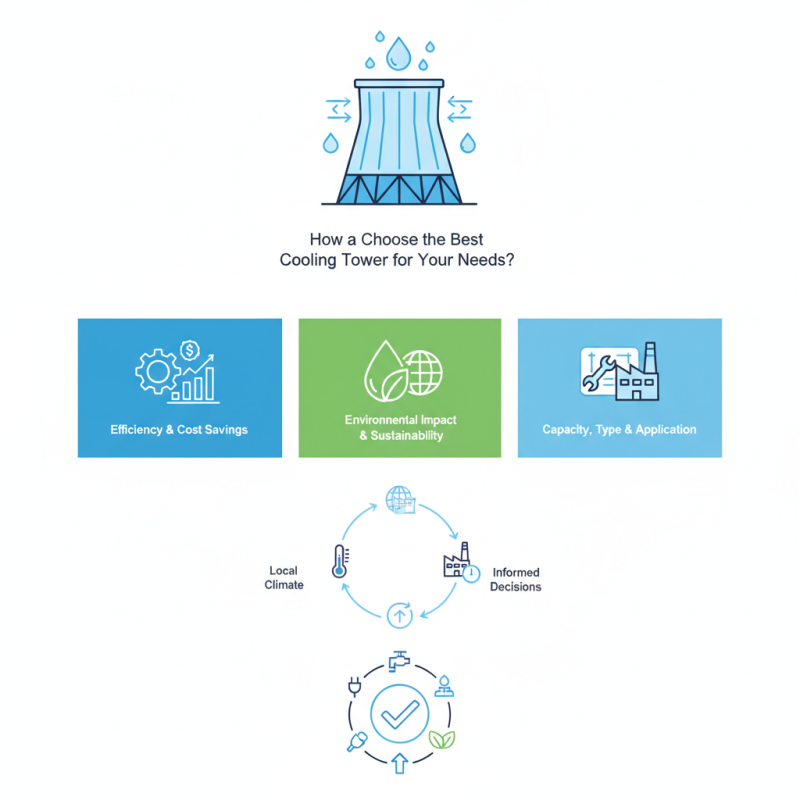
Factors to Consider When Selecting a Cooling Tower Type for Your Facility
When selecting a cooling tower, several important factors deserve attention. The facility's size plays a critical role. Larger operations often require more extensive cooling capacities. For instance, data indicates that a cooling tower’s efficiency decreases significantly with improper sizing, leading to energy losses of up to 30%. Understanding the thermal load is crucial for choosing the right system.
Water quality is another key factor. Contaminants can lead to scaling and corrosion. A recent study found that poor water conditions can reduce cooling tower lifespan by nearly 20%. Regular water treatment may be necessary, adding to operational costs. Not considering these factors can lead to unexpected maintenance issues.
The environment where the cooling tower will be installed also matters. Local climate impacts its performance. In humid regions, evaporative cooling may be less efficient. Conversely, arid areas can see rapid water loss. Depending on geographical variations, adjustments to the cooling system’s design may be required. These considerations are essential for maximizing efficiency and longevity of the cooling equipment.
Assessing Your Cooling Load Requirements: Calculating BTUs and GPM
When selecting a cooling tower, understanding your cooling load is essential. Cooling load is a critical factor in determining the efficiency of a cooling tower. It often gets overlooked. However, calculating the required BTUs (British Thermal Units) and GPM (gallons per minute) can help you make an informed choice.
Typically, a facility may need around 12,000 BTUs to cool just one ton of air. To convert that into water flow, a cooling tower may require roughly 2.4 GPM per ton of air. Therefore, knowing your total cooling load in tons can help you estimate the water flow needed. To find your cooling load, consider factors like indoor temperature, humidity levels, and the number of heat-generating equipment in your space. Every detail counts.
Many companies fail to account for peak usage periods. This can lead to underperformance. Sometimes, environmental factors like location and seasonal variations influence cooling needs significantly. Relying solely on average data may not suffice. Revisiting your calculations and considering various scenarios ensures reliability in performance. This approach provides a foundation for selecting a cooling tower that meets your specific requirements and contributes to energy efficiency.
Material Selection for Durability: Fiberglass vs. Steel Cooling Towers
When choosing a cooling tower, material selection plays a crucial role. Fiberglass and steel are two common options. Fiberglass cooling towers are lightweight and resistant to corrosion. They often require less maintenance over time. However, they can be more susceptible to UV degradation if not treated properly. This is an important fact to consider. An inadequate UV protection can lead to premature failures.
On the other hand, steel cooling towers offer exceptional strength. They can withstand harsh conditions and have a longer lifespan. Yet, they are prone to rust and corrosion if not coated properly. This can lead to significant long-term costs. Regular inspections are necessary to avoid unexpected expenses related to repairs.
Your choice may also depend on your specific environment. For coastal areas, fiberglass may outshine steel due to its corrosion resistance. In industrial settings, steel's durability may better support heavy-duty applications. Think about the climate, potential exposure to chemicals, and your budget. Every project has its unique demands. Ensure you view all options critically before making a decision.
How to Choose the Best Cooling Tower for Your Needs? - Material Selection for Durability: Fiberglass vs. Steel Cooling Towers
| Material | Durability | Corrosion Resistance | Cost | Maintenance | Weight |
| Fiberglass | High | Excellent | Moderate | Low | Lightweight |
| Steel | Moderate | Fair | Low | High | Heavy |
Energy Efficiency Ratings and Their Impact on Operating Costs
When selecting a cooling tower, energy efficiency is critical. Energy efficiency ratings indicate how much energy the tower consumes over its operational lifespan. According to recent industry reports, cooling towers can account for up to 30% of the total energy costs in large facilities. This makes understanding energy ratings even more important.
Higher efficiency towers may cost more upfront. However, the return on investment can be significant due to lower operational costs. For example, a cooling tower with a 5% better efficiency rating could save a facility thousands of dollars annually on energy bills. It’s crucial to balance initial costs against these long-term savings.
Choosing the right cooling tower can be complex. Factors like location, climate, and thermal load also matter. If not properly matched, even an energy-efficient tower could underperform, leading to higher costs and operational inefficiencies. Understanding and analyzing these aspects is essential for making an informed decision.
Understanding Maintenance Requirements and Longevity of Cooling Towers
When selecting a cooling tower, understanding its maintenance requirements is crucial. Regular maintenance extends its lifespan and efficiency. Reports indicate that cooling towers may last 15 to 30 years. However, neglect can lead to operational inefficiencies and costly repairs. For instance, a well-maintained tower can reduce energy consumption by up to 30%.
Tips for maintenance: Schedule regular inspections. Look for scaling, corrosion, or biological growth. Cleaning the fill media is essential. It ensures optimal heat transfer. Small issues can escalate quickly if overlooked.
Another crucial aspect is monitoring performance. Data shows that many cooling towers operate below optimal conditions due to lack of routine checks. Ensure water quality is tested regularly. High levels of debris or chemicals can shorten equipment life. The cost of proactive maintenance is often lower than emergency repairs.
Keeping a maintenance log helps. It tracks repairs and inspections. Reflect on whether your current maintenance practices are sufficient. Over time, small lapses can lead to significant deterioration.
Cooling Tower Maintenance Requirements and Longevity