What is Industrial Rfid Tablets and How Can They Benefit Your Business?
In the fast-evolving landscape of industry, "Industrial Rfid Tablets" stand out as a game-changing technology. These devices merge RFID capabilities with tablet functionalities, enabling companies to streamline operations and enhance inventory management. According to Dr. Emily Chen, a leading expert in industrial automation, “Industrial RFID Tablets empower businesses by improving data accuracy and operational efficiency.”
These tablets can track assets in real-time, reduce manual errors, and enhance communication across teams. Their rugged design ensures durability, making them suitable for various industrial environments. However, adopting this technology requires thoughtful consideration. Not all businesses may benefit equally, and the investment must align with operational goals.
Moreover, integrating Industrial RFID Tablets into existing systems can present challenges. Businesses must be prepared to train employees and adapt workflows. The potential is vast, yet the path to implementation must be navigated carefully. Crafting a tailored strategy is essential for reaping the benefits of this innovative technology.
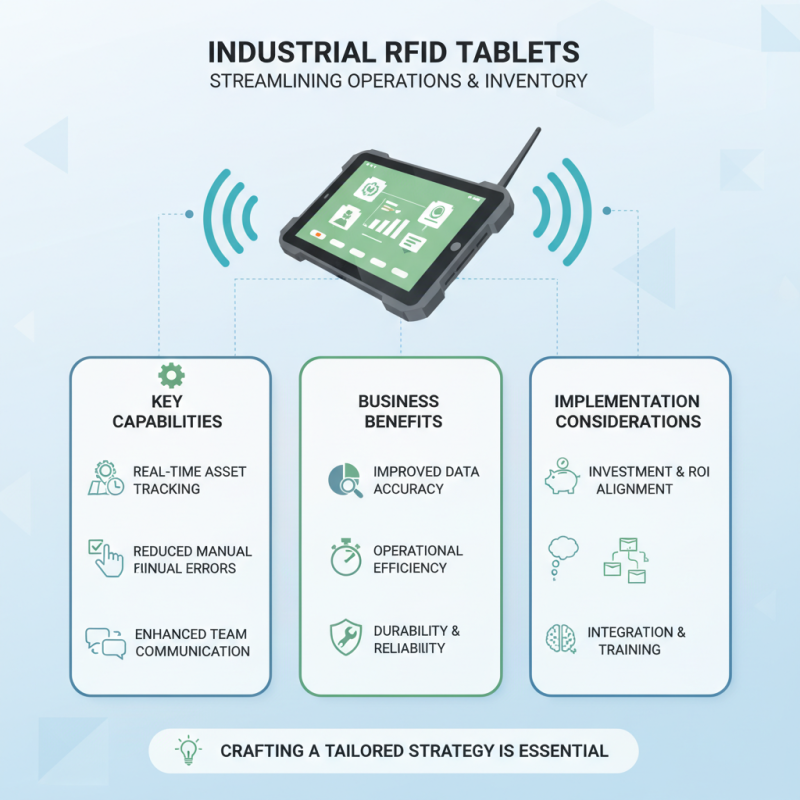
Understanding Industrial RFID Tablets and Their Technology
Industrial RFID tablets have emerged as a significant technological advancement in inventory and asset management. These devices combine RFID technology with rugged tablet form factors designed for harsh environments. According to a report from MarketsandMarkets, the global RFID market is projected to reach over $40 billion by 2025, signaling expansive growth and adoption across various sectors.
The core technology behind industrial RFID tablets is their capability to automatically capture and process data using radio waves. With their built-in RFID readers, these tablets streamline tracking processes, reducing human error and improving efficiency. A study published by RFID Journal indicated that the use of RFID technology can enhance inventory accuracy by up to 95%, leading to better resource management and faster decision-making. This is particularly beneficial in industries such as manufacturing and logistics, where tracking products without delays is crucial.
However, while RFID tablets offer numerous advantages, challenges remain. Not all environments are equally suited for this technology. Issues such as signal interference and compatibility with existing systems need careful consideration. Businesses must assess their infrastructure and workflows before integration. A piecemeal implementation can lead to suboptimal results, undermining the potential efficiency gains. Understanding these nuances is key to fully leveraging the benefits of industrial RFID tablets.
Key Features of Industrial RFID Tablets for Business Operations
Industrial RFID tablets combine advanced technology with rugged design. These devices offer unique features that greatly enhance business operations. Their durability makes them suitable for tough environments. They can withstand drops, moisture, and dust, ensuring longevity and reliability.
One key feature of industrial RFID tablets is their real-time inventory tracking. This functionality allows businesses to monitor stock levels continuously. It reduces the chances of overstocking or running out of essential supplies. Additionally, built-in RFID capabilities enable quick data capture. Employees can scan items efficiently, speeding up processes like shipping and receiving.
Another advantage lies in their user-friendly interfaces. These tablets can be customized for specific tasks, making them versatile tools. However, employees may require additional training to maximize their potential. This investment in education can lead to higher productivity in the long run. Overall, while industrial RFID tablets offer significant benefits, organizations must be willing to adapt to fully realize their advantages.
Advantages of Integrating RFID Technology into Business Processes
Integrating RFID technology into business processes can significantly enhance operational efficiency. According to a report by Grand View Research, the global RFID market is expected to reach $40 billion by 2027, growing at a compound annual growth rate (CAGR) of 14.5%. This exponential growth indicates that more businesses are recognizing the advantages of adopting RFID systems.
RFID tablets, as an example, allow for real-time tracking of inventory and assets. Businesses utilizing RFID can reduce manual inventory checks by up to 75%. This technology minimizes human error and boosts accuracy. Additionally, it speeds up the supply chain process, leading to quicker response times. A study from the University of Arkansas found that companies reported a 30% reduction in stock loss after implementing RFID solutions.
Despite these benefits, challenges remain. Initial setup costs can be high, which may deter some businesses. Moreover, training staff to effectively use RFID systems is essential. Failure to do so can lead to underutilization of the technology. Ensuring a seamless integration requires thoughtful planning and ongoing evaluation. Businesses should consider these factors when deciding to embrace RFID technology.
Use Cases of Industrial RFID Tablets Across Various Industries
Industrial RFID tablets are transforming various industries. These devices combine RFID technology with the capabilities of tablets. They enable real-time inventory tracking, asset management, and streamlined workflows.
In the manufacturing sector, RFID tablets enhance production efficiency. Workers can scan tags on products directly from the assembly line. This reduces human error and speeds up operations. Similarly, in logistics, these tablets allow for quick scanning of packages. They help in managing shipping and receiving, leading to fewer delays.
Retail also benefits significantly. RFID tablets simplify inventory checks and reduce stock discrepancies. Store managers can quickly locate items and track their movement. However, such implementations are not without challenges. Staff training is essential for optimal use. Sometimes, the technology may not integrate smoothly with existing systems. Addressing these issues is crucial for successful deployment.
What is Industrial RFID Tablets and How Can They Benefit Your Business? - Use Cases of Industrial RFID Tablets Across Various Industries
| Industry | Use Case | Benefits | Impact on Efficiency |
| Manufacturing | Inventory Management | Real-time tracking and lower stock discrepancies | Increased inventory accuracy by 30% |
| Retail | Asset Tracking | Improved product visibility and theft prevention | Reduction in shrinkage by 25% |
| Logistics | Shipping and Receiving | Faster processing times of shipments | Delivery time decreased by 15% |
| Healthcare | Patient Tracking | Enhanced patient safety and care | Improved patient care efficiency by 10% |
| Construction | Equipment Tracking | Increased accountability and maintenance scheduling | Reduced equipment loss by 40% |
Selecting the Right Industrial RFID Tablet for Your Business Needs
Selecting the right industrial RFID tablet for your business needs requires careful consideration of multiple factors. Industrial RFID tablets are increasingly vital for sectors such as warehousing, logistics, and manufacturing. According to a recent report by Research and Markets, the global RFID market is projected to reach $49.6 billion by 2026, highlighting the growing reliance on this technology.
When choosing an RFID tablet, assess the environment in which it will be used. Tablets designed for industrial use often feature rugged exteriors to withstand harsh conditions. Battery life is another crucial element. A tablet that can last through demanding shifts without frequent recharging will improve productivity. Some tablets offer a battery life of up to 12 hours, which is beneficial for long working hours.
Also consider the operating system and software compatibility. Some devices may have limitations that restrict performance in specific applications. Data security must not be overlooked either, as protecting sensitive information is paramount. As noted by IDC, 39% of businesses faced security breaches last year. Navigating these factors can be complex, and one size does not fit all. Balancing your specific business needs with available options will require some reflection and possibly adjustments in your approach.
Benefits of Industrial RFID Tablets for Businesses