
10 Robotic Gear Buying Tips for Global Buyers

Buying Robotic Gear for an international project is rarely a simple matter of comparing prices. A gripper may look suitable online, yet its payload rating, mounting pattern, or cycle life may not match your robot. Small mismatches matter. A few millimeters can affect installation, while an unclear duty-cycle rating can disrupt production planning.

This guide introduces ten practical buying tips for global buyers. It highlights how to check specifications, request technical drawings, assess supplier support, and compare total ownership costs. Ask for clear information on materials, tolerances, operating conditions, spare parts, and warranty coverage. Where possible, test a sample under realistic loads and speeds. Keep written records of what the supplier confirms; memory is not a purchasing system.

Cross-border orders add details worth checking. Confirm packaging, lead times, shipping terms, and the availability of service in your destination market. Ask which standards or certifications apply to the product and intended use, then verify relevant documents with qualified professionals. Requirements vary by location and application. Do not treat a product listing as proof of suitability.

A checklist helps, but it cannot replace sound engineering judgment. That is the awkward part. Buyers can still overlook a cable route, a maintenance interval, or a small interface conflict. These tips are designed to make those questions easier to raise before ordering. Careful checks will not guarantee a perfect purchase, but they can reduce avoidable surprises and support a more dependable robotic system.
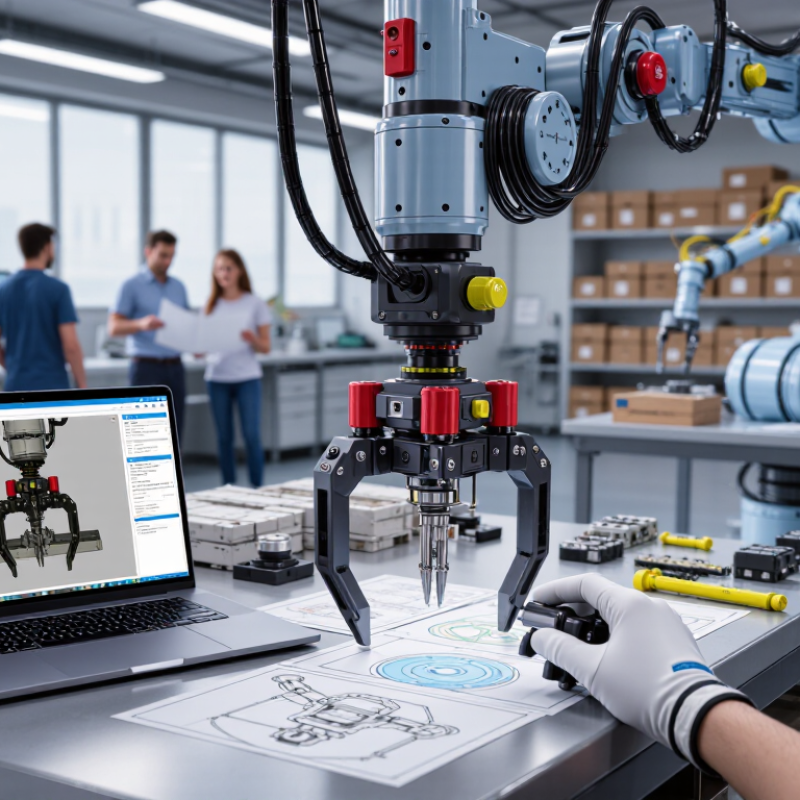
10 Robotic Gear Buying Tips for Global Buyers

Define Application Loads, Peak Torque, Speed, and Duty Cycle

Before choosing a robotic gear unit, map the load at the gearbox output—not just the payload. Include arm reach, tooling, cables, friction, and acceleration. A small gripper mounted far from the joint can create a surprisingly large moment. Record the motion profile for a typical cycle, including starts, stops, reversals, and any impact. Small details matter.

Tip: List continuous torque, peak torque, peak duration, and how often peaks occur. Check the peak against the manufacturer’s permitted limit and duration; a brief overload is not automatically acceptable. Also note output speed under load, not only the motor’s no-load speed. If measurements are uncertain, mark them as estimates and verify them during testing.

Duty cycle connects the numbers to heat and service life. A unit that handles a short torque spike may still overheat during repeated cycles with little cooling time. Compare operating time, idle time, ambient temperature, and mounting conditions with the supplier’s ratings. In sizing reviews, missed acceleration demands are a common source of surprises. Yet a calculation can still miss cable drag or changing payloads. Leave a sensible margin, then validate the choice on the actual robot.

Choose Gear Accuracy Using ISO 1328-1 Grades 1–11

When comparing robotic gears, read the ISO 1328-1 accuracy grade as one specification, not a complete performance promise. The standard classifies flank deviations for cylindrical gears; it does not rate every feature of a gearbox. Lower grade numbers indicate tighter tolerance levels: Grade 1 is finer than Grade 11. Numbers need context. A high-precision joint may benefit from a tighter grade, especially when repeatability, low vibration, or quiet motion matters. Yet buying the finest grade can add cost without improving a robot whose bearings, housing alignment, or control resolution set the real limit.

Ask suppliers for the stated grade, measurement report, gear size, and inspection conditions. Check whether the report covers actual tooth flank deviations, not only a general certificate. Compare backlash, runout, tooth thickness, and contact pattern separately; these can affect positioning and noise. A useful report identifies the standard edition and measurement method. Small details matter. Test gears in the intended assembly, too. Mounting error, lubricant, temperature, and load can change results in service. For a compact robot wrist, a moderate grade with stable assembly may outperform a tighter-grade gear fitted poorly. A grade number is an easy shortcut to rely on, but representative motion tests reveal whether the selected tolerance fits the application.

10 Robotic Gear Buying Tips for Global Buyers - Choose Gear Accuracy Using ISO 1328-1 Grades 1–11
# Buying Tip What to Specify Buyer Check Practical Note
1 Select an accuracy grade for the application ISO 1328-1 grade, applicable standard edition, and the gear type in scope Confirm the supplier’s stated grade applies to the specified gear and its measured flanks Grades run from 1 to 11; grade 1 is the finest accuracy class and grade 11 is coarser. The required class depends on design and operating needs.
2 Define the complete gear geometry Gear type, module or diametral pitch, tooth count, pressure angle, helix angle, facewidth, and reference diameter Match the drawing and inspection plan to the same geometry and units ISO 1328-1 concerns flank deviations of involute cylindrical gears; a grade alone does not identify a complete gear specification.
3 Set backlash separately from accuracy grade Target backlash or lost motion, measurement method, operating temperature, and assembly condition Request a measured value or defined acceptance range for the assembled gear pair or gearbox ISO 1328-1 flank accuracy grades do not, by themselves, specify backlash or gearbox lost motion.
4 Match capacity to the robot duty cycle Continuous and peak torque, speed, acceleration, reversing frequency, and expected service life Check ratings at the actual operating speed, load spectrum, lubrication, and thermal conditions A gear’s accuracy grade is not a torque-capacity or fatigue-life rating.
5 Specify material and heat treatment Material grade, heat-treatment route, hardness requirements, and any case-depth requirement Ask for material and heat-treatment records where required by the application The suitable specification depends on load, wear, noise, size, and manufacturing process; do not infer material properties from an accuracy grade.
6 Agree on the inspection evidence Inspection items, sampling plan, measurement conditions, and report format Request traceable results for applicable profile, helix, pitch, or runout checks, as agreed in the drawing or purchase specification Define acceptance criteria before production; a general statement such as “ISO grade compliant” may not provide enough inspection detail.
7 Check noise and vibration in the intended assembly Test speed, load, mounting, lubrication, microphone or sensor position, and acceptance limits Compare test results using the same setup and operating conditions Noise depends on the complete transmission and test setup, not only on the gear flank accuracy grade.
8 Verify mounting and interface requirements Shaft and bore dimensions, fits, key or spline details, mounting datums, and allowable alignment Check interface tolerances and datum references against the mating components Assembly misalignment and bearing or housing variation can affect performance even when gear flanks meet their specified grade.
9 Plan lubrication and operating environment Lubricant type and supply method, temperature range, contamination exposure, and maintenance interval Confirm the selected gear and lubricant are suitable for the actual operating environment Lubrication and temperature influence wear and service life; they are not specified by the ISO 1328-1 accuracy grade.
10 Clarify delivery, documentation, and change control Drawing revision, lot identification, required documents, packaging, and approval process for changes Align purchase order, approved drawing, inspection report, and delivered lot records For global sourcing, state units, document language, delivery terms, and any import or traceability requirements in the purchase documents.

Note: ISO 1328-1 grades classify specified flank deviations for applicable involute cylindrical gears. Confirm the standard edition, gear scope, geometry, and agreed inspection requirements in the technical specification.

Check Tooth-Bending and Pitting Capacity with ISO 6336

For robotic gear purchases, ask suppliers to assess both tooth-root bending strength and flank pitting resistance using ISO 6336. These are different failure risks. Bending checks whether repeated torque can crack a tooth near its root. Pitting checks whether contact pressure can damage the tooth surface over time. Small details matter.

A useful calculation needs more than nominal torque. Request the gear geometry, material, heat-treatment details, quality grade, speed, duty cycle, and load spectrum used. For a robot arm, repeated starts, sudden stops, and changing payloads can make peak loads more important than average loads. Ask for the safety factors and the assumptions behind them. A neat report can still hide a weak assumption. Check that lubrication, operating temperature, and alignment match your application, not just a laboratory case. ISO 6336 calculations support comparison, but they do not guarantee service life, especially when real loads are uncertain. For planetary or other specialized arrangements, confirm that the chosen calculation method fits the gear design. If input data are incomplete, say so and request a revised assessment. That may delay a quote. It is still better than treating a precise-looking number as certainty.

Compare Robot Pose Repeatability Using ISO 9283 Test Methods

For global buyers, ISO 9283 provides a common framework for evaluating industrial robot performance. Its test methods include pose accuracy and pose repeatability, but a single figure cannot describe every working condition. Compare results only when the test setups are clearly stated.

For pose repeatability, check how closely the robot returns to the same commanded position and orientation across repeated movements. Ask for the test pose locations, payload, approach direction, motion speed, mounting conditions, and measurement method. Warm-up and ambient temperature matter, too. Small setup changes can shift the result. Numbers can mislead.

A useful supplier report separates position variation from orientation variation and identifies the conditions used for testing. Confirm whether the payload resembles your gripper and workpiece, and whether the tested poses reflect your actual cell. A robot tested near the center of its workspace may perform differently near an outer reach. Compare measurement uncertainty as well as reported values; otherwise, tiny differences may be meaningless. ISO-based testing improves comparison, but it does not guarantee performance in your installation. It is easy to overlook that. Ask how the robot was mounted and whether the test configuration matches your planned setup.

Plan Regional Spares for 4.28 Million Robots in Service (IFR, 2023)

10 Robotic Gear Buying Tips for Global Buyers

IFR’s World Robotics 2023 report estimates 4.28 million industrial robots were in operation worldwide. That installed base makes spare-parts planning a service issue, not an afterthought. A failed joint encoder or drive can stop a cell while a small component crosses borders. Keep a regional list of critical parts, lead times, and compatible robot models.

The same IFR report recorded 553,052 new installations in 2022. Asia accounted for 73% of installations, Europe 15%, and the Americas 10%. Those regional differences matter. A single central warehouse may look efficient on paper, but customs delays and distance can stretch repair times. Place fast-moving items near major service clusters; hold expensive, low-use assemblies centrally. Not every site needs a full duplicate kit.

Build the plan from maintenance records, not guesswork. Track failure rates, replacement intervals, and supplier lead-time variation by part number. Store seals and batteries under suitable conditions, and label bins with model compatibility and revision details. Run a quarterly count. It will not be perfect. Review the list after each outage, especially when a supposedly interchangeable component does not fit. Cite: IFR, World Robotics 2023.

Article Source:

CONTACT US