
China Top 10 PSA Activated Carbon Manufacturers
China’s position in the Psa Activated Carbon supply chain deserves careful evaluation, not just a list of factory names. In pressure swing adsorption systems, activated carbon can help remove selected impurities, often alongside molecular sieves or other adsorbents. The right choice depends on feed composition, operating pressure, moisture, and the required product purity. Small differences matter.
The International Energy Agency’s Global Hydrogen Review 2024 reports that global hydrogen demand reached almost 100 million tonnes in 2023. That figure provides useful context for gas-purification needs, but it is not a measure of activated-carbon demand. Buyers should therefore assess manufacturers through verifiable product data: pore structure, iodine number, hardness, ash content, particle-size consistency, and pressure-drop performance. A high iodine number alone does not guarantee strong performance in a specific PSA cycle.
This overview of China’s top 10 PSA activated carbon manufacturers is intended as a starting point for supplier research. It considers product focus, production capability, quality documentation, and application support, while recognizing that public company claims can be difficult to compare. Not every grade fits. Before making a decision, request recent test reports and samples, then validate performance under realistic operating conditions. A shortlist is useful, but it is not a verdict; long-term consistency may matter more than a polished catalogue.
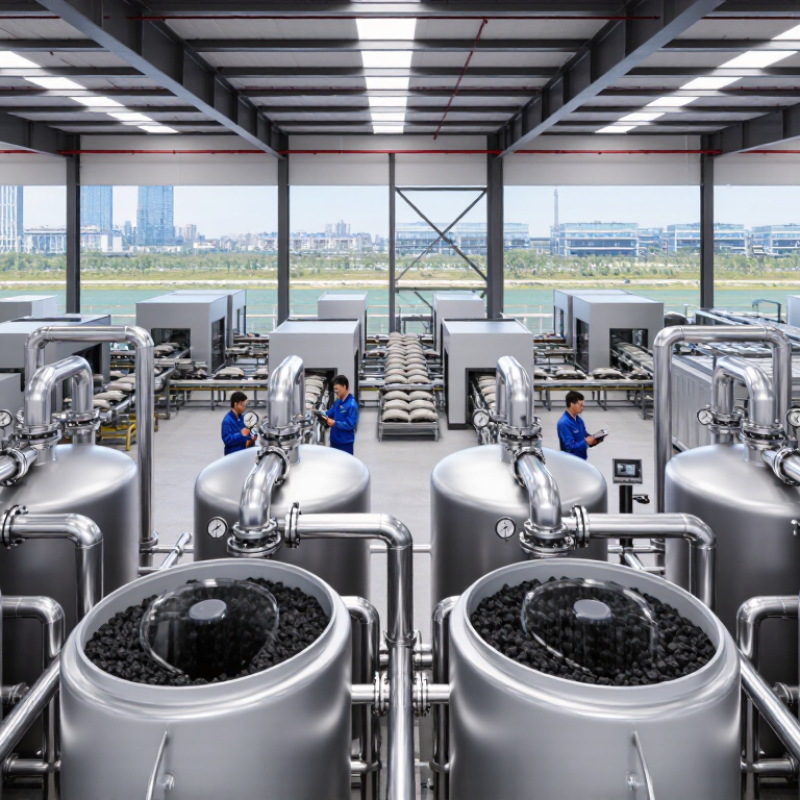
Understanding PSA Activated Carbon and Its Role
Pressure swing adsorption (PSA) uses changes in pressure to separate gas mixtures. Activated carbon can serve as an adsorbent, capturing selected molecules on its porous surface while other gases pass through. During regeneration, pressure drops and some captured material is released. Pressure changes matter.
In practice, performance depends on pore structure, gas composition, humidity, temperature, and cycle timing. A bed exposed to wet or oily feed may lose useful capacity, so pretreatment and routine monitoring matter. Operators often track outlet gas quality and pressure behavior rather than relying on a single headline adsorption value. Small shifts can signal a developing problem.
The term “PSA activated carbon” can also cause confusion. Standard activated carbon is not automatically interchangeable with carbon molecular sieve, which is engineered for selective gas separation, often by differences in diffusion rates. That distinction matters. Selection should follow the target gas, operating conditions, and required purity, with manufacturer data checked against real feed conditions. One detail is easy to overlook: a material that performs well in a laboratory test may behave differently in a rapidly cycled industrial bed. Rechecking assumptions is sensible.
China Top 10 PSA Activated Carbon Manufacturers - Understanding PSA Activated Carbon and Its Role
The table below summarizes ten practical material and process factors for evaluating PSA activated carbon. It is a technical guide, not a ranking of companies or brands.
| No. | Evaluation Dimension | Factual Description | Why It Matters in PSA |
|---|---|---|---|
| 1 | Feedstock | Activated carbon can be produced from carbon-rich materials such as coal, coconut shell, and wood. Feedstock influences pore structure, ash content, and mechanical properties. | Feedstock selection affects suitability for gas purification and the consistency of the finished adsorbent. |
| 2 | Activation method | Common production routes include physical activation with steam or carbon dioxide and chemical activation using activating agents. | The process helps create pores and influences adsorption capacity, pore-size distribution, and surface chemistry. |
| 3 | Pore structure | Activated carbon contains pores of different sizes. Micropores are smaller than 2 nm, mesopores range from 2 to 50 nm, and macropores are larger than 50 nm. | Pore-size distribution affects how gases access adsorption sites and which molecules the material can capture effectively. |
| 4 | Surface chemistry | Surface functional groups and mineral content vary with the feedstock and manufacturing process. These characteristics can influence interactions with particular gas components. | Material selection should match the target impurities and the operating conditions of the PSA process. |
| 5 | Adsorption target | Activated carbon is commonly used to adsorb selected contaminants, including many organic vapors. Performance depends on the gas mixture, pressure, temperature, and humidity. | A product should be evaluated against the actual feed gas and target contaminant rather than by a general surface-area figure alone. |
| 6 | Role in a PSA system | Pressure swing adsorption separates gas components by changing pressure to adsorb and release them. Activated carbon may serve as an adsorbent or as a guard layer for selected impurities, depending on system design. | The required material depends on the process objective; activated carbon is not automatically the principal separation medium in every PSA unit. |
| 7 | Distinction from carbon molecular sieve | Carbon molecular sieve (CMS) is a specially manufactured carbon adsorbent with controlled pore characteristics. It is a distinct product category from general-purpose activated carbon. | Nitrogen PSA systems commonly use CMS for oxygen-nitrogen separation; an activated-carbon product should not be assumed to be a direct substitute. |
| 8 | Particle size and form | Commercial activated carbon is available in forms such as granular, pelletized, and powdered material, with particle specifications varying by product. | Particle dimensions influence pressure drop, contact time, packing, and resistance to attrition in a fixed bed. |
| 9 | Moisture, ash, and strength | Moisture and ash are measurable properties of activated carbon. Hardness or abrasion-related tests are used to assess resistance to breakdown during handling and operation. | These properties can affect usable adsorption capacity, dust formation, bed pressure drop, and material handling. |
| 10 | Testing and operating data | Useful documentation includes test methods and results for properties such as moisture, ash, particle-size distribution, bulk density, and adsorption performance under specified conditions. | Comparable test conditions and application-specific trials provide a sounder basis for selection than unqualified claims or isolated specification values. |