China Top 10 UV Spectroscopy Machine Manufacturers
China has become an important source of laboratory analytical equipment, including UV-visible instruments for research, education, quality control, and manufacturing. This guide introduces ten China-based manufacturers in the Uv Spectroscopy Machine market. It aims to help buyers compare options, not declare one universal winner. Needs vary. A university teaching lab may prioritize simple operation and durable construction. A testing facility may need tighter wavelength accuracy, validation records, and dependable technical support.
When comparing suppliers, look beyond product photos and headline specifications. Check wavelength range, spectral bandwidth, photometric accuracy, stray-light performance, scan speed, and compatible cuvette sizes. Ask whether the software exports data and works with your operating system. A clear manual matters. So does a real response from technical support. Confirm warranty terms, spare-part availability, installation, training, and calibration arrangements before ordering. Where possible, review current datasheets and request a demonstration using representative samples. A polished brochure is not proof. Manufacturers may update models, accessories, and service coverage, while published figures can vary by configuration. This overview is a starting point for careful research, not a substitute for application testing or direct supplier verification. The right instrument should fit your method, budget, and workflow—and perform consistently beyond the first month.
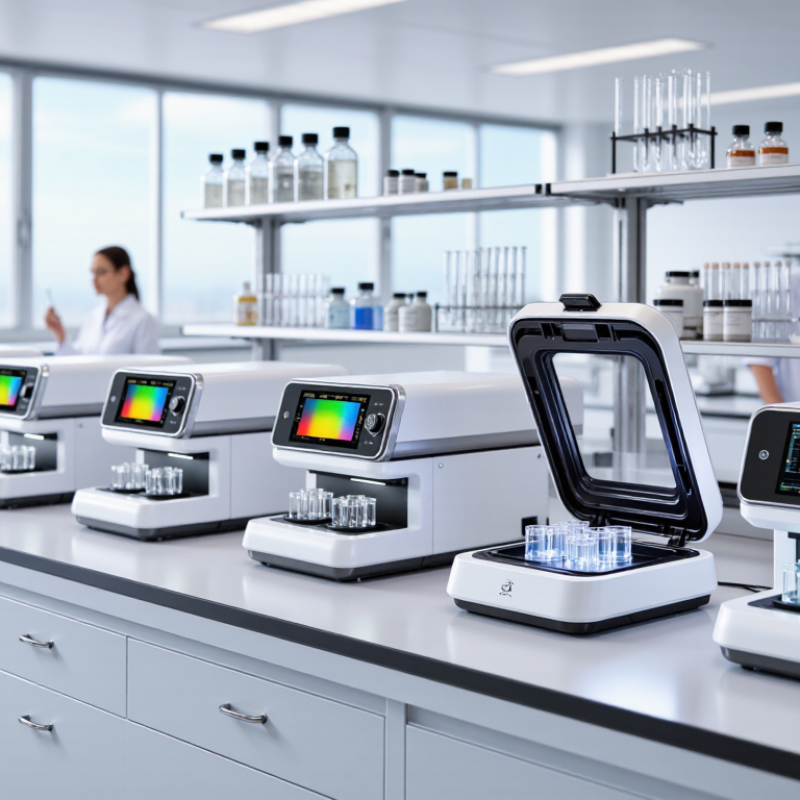
Overview of UV Spectroscopy Machines and Their Main Applications
UV spectroscopy machines measure how much ultraviolet or visible light a sample absorbs or transmits. Many instruments scan across selected wavelengths, while simpler units take readings at fixed points. A typical UV-Visible system covers ultraviolet and visible regions, though its exact range depends on the instrument and detector.
Small details matter. For ultraviolet measurements, quartz cuvettes are commonly used because ordinary glass can absorb some UV light. Fingerprints, bubbles, or a poorly prepared blank may distort a reading. In routine work, operators check the baseline, clean the cuvette, and repeat unexpected measurements. The display can look precise, but precision is not the same as accuracy.
These machines support water testing, pharmaceutical quality checks, food analysis, and materials research. A lab might compare a water sample’s absorbance with a calibration curve, or track a reaction as its color changes. Results depend on sample preparation and method settings, not just the instrument. A clean spectrum can still hide a poor sample. Even careful teams sometimes need to revisit their assumptions.
China’s UV Spectroscopy Manufacturing Industry at a Glance
China’s UV spectroscopy manufacturing industry draws on a broad supply chain, including optical components, light sources, detectors, electronics, and precision mechanical parts. Manufacturers serve laboratories in environmental testing, education, pharmaceuticals, and food quality control. Product differences often come down to practical details: wavelength accuracy, baseline stability, software usability, and service access.
China’s National Bureau of Statistics reported that national research and development expenditure reached 3.33 trillion yuan in 2023, or 2.64% of GDP. This figure indicates a substantial research environment, but it is not a measure of UV instrument output. Official statistics do not separately report the number of domestic UV spectrometers produced, so claims about market share or production leadership need careful sourcing. In practice, buyers should compare published specifications with repeatability data and independent test results. A polished datasheet is not enough.
Tips: Before choosing an instrument, check wavelength accuracy, stray-light performance, and baseline drift. Test it with your own samples when possible. Small differences matter. A busy laboratory may also value simple calibration and responsive technical support as much as scan speed.
Criteria for Selecting Leading UV Spectroscopy Manufacturers
China Top 10 UV Spectroscopy Machine Manufacturers: Criteria for Selecting Leading UV Spectroscopy Manufacturers
Choosing a manufacturer requires more than comparing wavelength ranges and prices. Check performance against USP General Chapter <857>, which addresses wavelength accuracy, photometric accuracy, resolution, and stray light. NIST’s SRM 2034 reference data documents holmium-oxide wavelength peaks from about 241.5 to 640.3 nm, offering a practical basis for checking calibration claims. Ask for test records, not just a specification sheet. ASTM E275 also outlines how UV-Vis instrument performance can be described and measured. Small differences matter.
Assess how the instrument performs in your actual workflow. For routine liquid samples, inspect cuvette compatibility, baseline stability, warm-up time, and software export options. For shared laboratories, ask about service response times, operator training, spare-part availability, and documented maintenance. A broad wavelength range is not automatically useful if the instrument lacks repeatability at your working wavelengths. One detail is easy to miss: request a demonstration using a representative sample, not only a clean standard. Supplier claims can look convincing on paper.
Tips: Compare repeatability and accuracy using the same reference material and conditions. Request the latest calibration and service records. Check whether staff can resolve common issues remotely. A low purchase price may bring higher operating costs; sometimes the service terms deserve more attention.
Profiles of China’s Top 10 UV Spectroscopy Machine Manufacturers
China Top 10 UV Spectroscopy Machine Manufacturers
Profiles of China’s Top 10 UV Spectroscopy Machine Manufacturers
A useful profile compares more than price and product range. Examine each manufacturer’s optical design, wavelength accuracy, stray-light control, detector options, and local service capacity. For routine water testing, a stable baseline and clear software workflow may matter more than a long feature list. For research labs, sample accessories and validation support deserve closer inspection. The National Bureau of Statistics reported that China’s R&D expenditure reached 3.3357 trillion yuan in 2023, or 2.64% of GDP. This broader investment context does not prove UV instrument performance, but it helps explain growing attention to laboratory equipment and technical support.
When assessing ten manufacturers, request repeatability data, calibration records, and application notes for your sample types. Compare instrument specifications under the same measurement conditions; otherwise, headline figures can mislead. Ask how service teams handle lamp replacement, software updates, and repair timelines. A polished brochure is not enough. Some public profiles offer limited independent test evidence, so buyers should verify claims with demonstrations and documented results.
Tips: Measure a blank and a reference standard before comparing instruments. Check warranty terms and confirm that consumables are readily available. Small details matter.
China Top 10 UV Spectroscopy Machine Manufacturers
Profiles of China’s Top 10 UV Spectroscopy Machine Manufacturers
The chart shows commonly used UV band boundaries: UV-C spans 100–280 nm, UV-B 280–315 nm, and UV-A 315–400 nm. These are reference wavelength ranges, not company-specific instrument specifications; conventions may vary by application.
Comparing Their Products, Technologies, and Service Capabilities
Comparing China’s ten leading UV spectroscopy machine manufacturers means looking beyond price and wavelength range. Product lines generally span compact single-beam units for routine checks, double-beam systems for stable quantitative work, and diode-array instruments for rapid full-spectrum scans. Grand View Research estimated the global UV-Vis spectroscopy market at about US$1.2 billion in 2023, with growth projected at roughly 6% annually. That demand puts pressure on suppliers to offer reliable optics, not just attractive specifications.
Technology differences show up at the bench. Buyers should compare wavelength accuracy, photometric repeatability, stray-light control, bandwidth, and software audit trails. A neat touchscreen cannot correct a drifting lamp. Some models suit teaching labs; others support quality control with automated sampling and method storage. The fit depends on sample volume, throughput, and whether operators need single-wavelength readings or complete spectra.
Service capability matters just as much. Ask about installation, staff training, calibration records, spare-lamp availability, and response times outside major cities. The ISO/IEC 17025 framework stresses metrological traceability and competent calibration, useful benchmarks when reviewing service claims. Not every catalog states these details clearly. That is a real comparison gap. A careful shortlist should test representative samples, inspect raw data exports, and confirm local support before purchase.