
China Top Cold Plunge Cooling Unit Suppliers?
The search for China Top Cold Plunge Cooling Unit Suppliers reflects a wider shift toward measurable recovery, thermal therapy, and home wellness. The Global Wellness Institute reported that the global wellness economy reached approximately $6.3 trillion in 2023. It also projects nearly $9 trillion by 2028. These figures show strong demand, but they do not guarantee reliable equipment.
The cold plunge sector remains difficult to measure. Market research firms often classify chillers, ice baths, hydrotherapy systems, and wellness appliances differently. Data remains uneven. Therefore, supplier comparisons require more than factory photos or attractive pricing. A dependable Cold Plunge Cooling Unit should maintain stable water temperatures, support continuous filtration, and manage heat safely in real operating conditions.
This guide examines Chinese suppliers through practical and technical criteria. These include cooling capacity, compressor quality, circulation flow, noise levels, energy use, sanitation options, and replacement-part availability. Testing records, product certifications, factory experience, and export history also deserve close attention. A unit that cools a small indoor tub may struggle beside a busy fitness club. That difference matters.
Public reports from organizations such as the Global Wellness Institute provide useful market context. However, they rarely verify individual manufacturers. Buyers must request clear specifications, performance data, warranty terms, and sample testing. No ranking is flawless. Supplier information can change quickly, and some claims need independent confirmation.
For that reason, this overview focuses on evidence rather than promotional language. It aims to help distributors, spa operators, hotels, and private buyers identify capable Chinese partners with realistic expectations. Reliability is built through documentation, testing, service, and honest technical discussion.
Cold Plunge Cooling Units: Definition, Components, and Key Performance Metrics
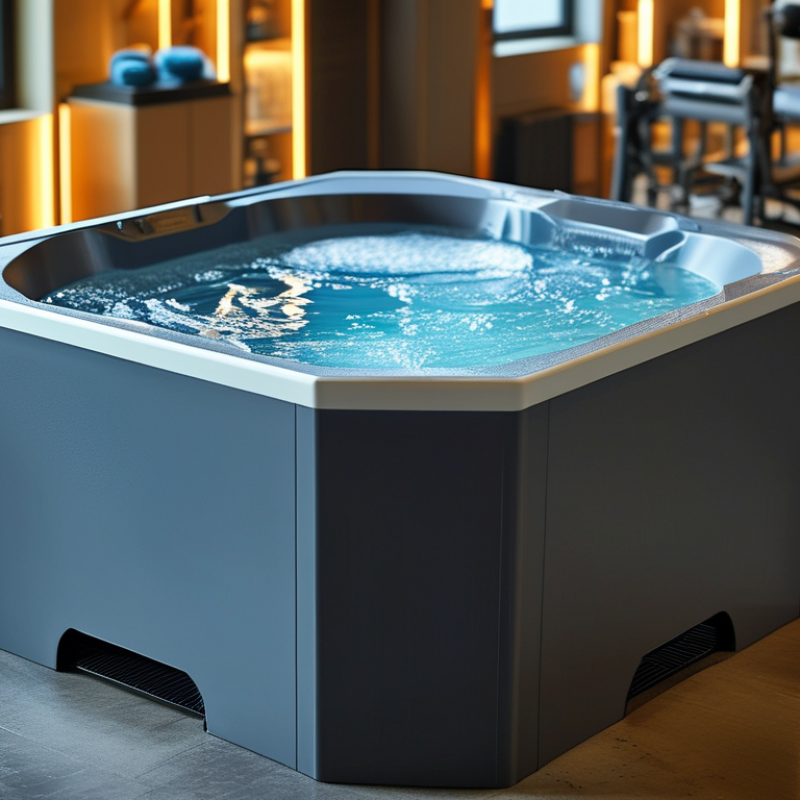
A cold plunge cooling unit is a refrigeration system that lowers and maintains water temperature for controlled cold-water immersion. It usually includes a compressor, condenser, evaporator, circulation pump, filter, controller, and insulated plumbing. Some units also use ozone or ultraviolet treatment, but water sanitation must follow local safety guidance.
When evaluating China-based suppliers, buyers should inspect measured performance, not only catalog claims. Cooling capacity, temperature range, flow rate, energy consumption, noise level, and recovery time are key metrics. A useful test records how quickly the unit cools a filled tub from 20°C to 10°C. Ambient temperature matters. Results can change indoors and outdoors.
The compressor should match the tub’s water volume and insulation quality. A powerful unit may cool quickly, yet consume more electricity and create stronger vibration. Poorly sized pumps can reduce circulation and cause uneven temperatures. I would request factory test reports, wiring diagrams, material specifications, and samples before a large order. Ask how filters are replaced and how faults are diagnosed.
One detail is easy to overlook: condensation around connections. It can damage nearby surfaces over time. Supplier communication also deserves testing. Clear answers are reassuring; vague promises are not. Performance may decline in hot weather, so a single laboratory figure cannot represent every installation. There is still room for better field data.
China Top Cold Plunge Cooling Unit Suppliers? - Cold Plunge Cooling Units: Definition, Components, and Key Performance Metrics
| Evaluation Dimension | Definition or Specification | Typical Practical Range | Why It Matters When Selecting a Supplier |
|---|---|---|---|
| Product Definition | A cold plunge cooling unit is a refrigeration system designed to remove heat from plunge-bath water and maintain a selected low temperature. | Commonly configured for residential, commercial, wellness, and athletic-recovery applications. | Clarifies whether the equipment is a dedicated water chiller rather than a general-purpose air-conditioning or refrigeration product. |
| Cooling Method | Most units use a vapor-compression refrigeration cycle with a compressor, condenser, expansion device, and water-side heat exchanger. | Air-cooled systems are common; water-cooled versions may be used where heat rejection and ventilation require special handling. | The cooling method affects installation requirements, noise, heat discharge, maintenance, and operating cost. |
| Recommended Water Volume | The water volume that the unit can cool effectively under specified ambient, starting-water, and insulation conditions. | Approximately 300–1,500 L for many compact and mid-size systems; larger commercial systems may support more. | A mismatch between tank volume and chiller capacity can result in slow pull-down, excessive runtime, or unstable temperature control. |
| Temperature Setpoint | The target water temperature selected through a controller, thermostat, or digital interface. | Many cold-plunge applications operate around 3–15 °C, depending on user preference and operating conditions. | The supplier should state the minimum achievable temperature and the conditions used to verify it. |
| Cooling Capacity | The rate at which the unit removes heat from the water, normally expressed in watts, kilowatts, BTU/h, or horsepower-equivalent marketing ratings. | Compact systems are often rated from about 0.5–2.0 kW of cooling capacity; actual output varies with test conditions. | Cooling capacity should be compared using the same inlet-water temperature, ambient temperature, and flow conditions. |
| Pull-Down Time | The time required to reduce the water from an initial temperature to a specified target temperature. | Often several hours for a full tank; time depends on water volume, insulation, starting temperature, and cooling capacity. | A credible supplier should provide test data rather than a pull-down time without operating conditions. |
| Water Flow Rate | The volume of water circulated through the filtration and heat-exchange loop per unit of time. | Common compact-system pump ratings are approximately 20–60 L/min, subject to head pressure and plumbing configuration. | Adequate flow supports heat transfer and filtration, while excessive flow may increase noise and energy use. |
| Water-Side Heat Exchanger | The component that transfers heat from the circulating plunge water to the refrigerant circuit without mixing the two fluids. | Titanium heat exchangers are widely selected for water-treatment compatibility and corrosion resistance. | Material selection is important when using salt, disinfectants, ozone, or other water-treatment methods. |
| Filtration and Sanitation | Filtration removes suspended particles; sanitation systems help control microorganisms in the recirculating water. | Systems may include a replaceable cartridge filter, UV treatment, ozone, chemical dosing, or a combination. | Cooling performance and water hygiene are separate functions, so both should be evaluated before purchase. |
| Energy Consumption | Electrical power consumed by the compressor, fan, pump, controls, and optional sanitation components during operation. | Many small systems use roughly 0.5–2.5 kW while actively cooling, depending on capacity and ambient conditions. | Ask for input power, rated current, duty-cycle assumptions, and standby consumption instead of relying only on cooling-capacity claims. |
| Noise Level | The sound pressure produced by the compressor, condenser fan, water pump, and cabinet vibration. | Approximately 45–65 dB(A) is a common stated range for compact air-cooled equipment, measured conditions permitting. | Noise measurements are meaningful only when the distance, room conditions, and operating mode are disclosed. |
| Electrical Supply | The voltage, frequency, phase, plug type, circuit protection, and maximum current required for safe operation. | Common configurations include 220–240 V at 50/60 Hz; regional versions may require different electrical specifications. | Electrical compatibility must be confirmed before ordering to avoid unsafe operation or costly modifications. |
| Refrigerant Information | The refrigerant type, charge quantity, safety classification, and applicable environmental requirements. | Refrigerant selection varies by model and market; documentation should identify the exact refrigerant and compliance status. | This affects serviceability, import requirements, technician qualifications, and long-term regulatory compliance. |
| Operating Environment | The permissible ambient-temperature, humidity, ventilation, and installation conditions. | Many air-cooled units are designed for indoor or sheltered outdoor use, but the specified ambient range must be checked. | High ambient temperature, inadequate ventilation, and direct weather exposure can reduce capacity and shorten service life. |
| Cabinet Protection | The enclosure’s resistance to dust, water ingress, corrosion, and accidental contact with electrical parts. | Protection ratings differ by design and market; an IP rating should be verified from technical documentation. | The enclosure must match the installation location, especially in wet, humid, coastal, or commercial environments. |
| Supplier Verification | Review technical datasheets, sample testing, quality-control records, warranty terms, spare-parts availability, and after-sales support. | A qualified supplier should provide consistent specifications, traceable testing information, and clear installation documentation. | Independent verification helps distinguish tested cooling performance from incomplete, inconsistent, or non-comparable claims. |
Note: Performance ranges are general industry-oriented reference values. Actual results depend on tank volume, insulation, ambient temperature, water flow, starting-water temperature, filtration configuration, and electrical conditions.