
Top Comma Blade Coating Machine Manufacturers for Buyers
Choosing a Comma Blade Coating Machine manufacturer is a practical decision, not just a price comparison. The right equipment must suit the material, production speed, coating width, and quality targets of your line. A machine that handles a thin adhesive well may not deliver the same results with a thicker slurry. Small details matter. Blade adjustment, web tension, drying capacity, and cleanup access can shape daily production.
This guide introduces manufacturers buyers may want to evaluate and explains what to check before requesting a quotation. Compare stated coating tolerances with trial results, and ask how performance changes across different materials and operating speeds. Review installation support, operator training, spare-part availability, and typical lead times. Request references from customers with similar production needs, where available. Clear answers are useful; vague claims deserve follow-up.
No supplier fits every factory. A polished brochure can also leave setup limitations unclear. Buyers should confirm specifications in writing and, when possible, test representative material before committing. These checks do not remove every risk, but they make comparisons more grounded. The goal is not simply to find a capable machine. It is to identify a manufacturer whose technical support, communication, and equipment match the realities of your production floor.
Understanding Comma Blade Coating Machines and Their Applications
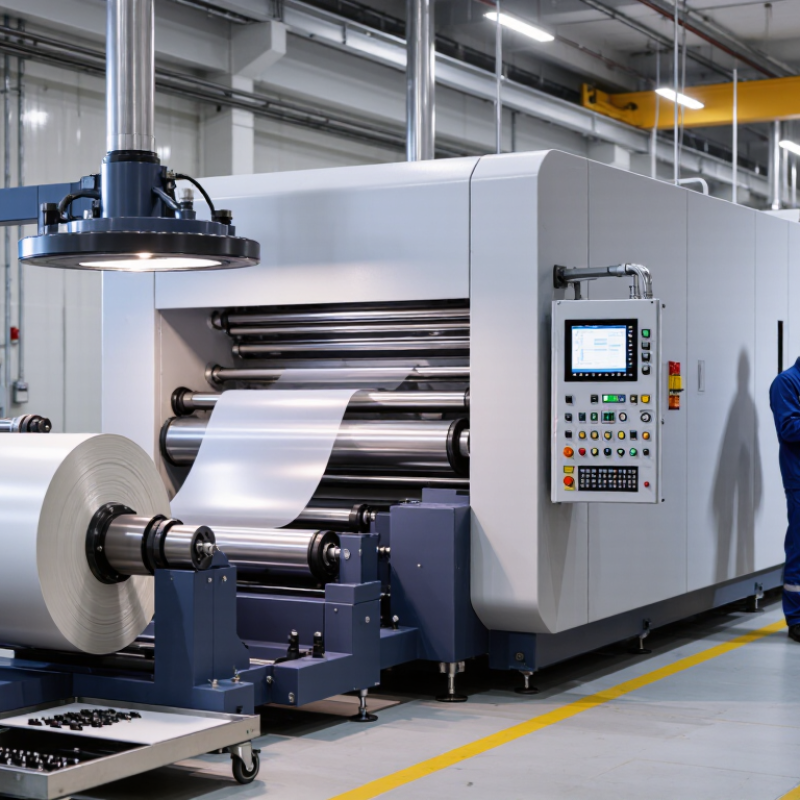
Comma blade coating machines spread liquid onto a moving web using a curved blade and a controlled gap. The setup suits films, paper, release liners, and adhesive layers. Operators adjust blade position, coating speed, and slurry viscosity to control wet-film thickness. A small gap change can leave visible streaks across the roll. That matters.
Typical applications include pressure-sensitive tapes, labels, optical films, and protective laminates. Grand View Research estimated the global pressure-sensitive adhesives market at USD 13.3 billion in 2023, with projected growth of 5.2% annually from 2024 to 2030. This demand supports interest in consistent coating equipment, but market growth alone does not prove a machine fits a specific production line. Buyers should test their actual material.
During a trial, check edge quality, thickness variation, drying behavior, and how quickly operators can clean the blade. Ask manufacturers for sample runs using your substrate and coating formula. A neat sample is not enough. Long-run stability matters more, and some materials may still require repeated adjustment. Industry reports give useful context, not machine-performance guarantees.
Top Comma Blade Coating Machine Manufacturers for Buyers - Understanding Comma Blade Coating Machines and Their Applications
| Machine Configuration | Typical Applications | Suitable Coating Materials | Key Advantages | Important Buyer Checks |
|---|---|---|---|---|
| Laboratory or benchtop comma coater | Formulation screening, coating trials, and small-sample process development | Liquid or paste-like formulations that can be metered through a coating head | Uses relatively little material and allows convenient adjustment of blade gap and substrate speed | Confirm usable coating width, gap-adjustment resolution, substrate-handling method, and cleaning access |
| Pilot-scale roll-to-roll coater | Scale-up trials for flexible films, coated papers, and other web materials | Adhesives, primers, functional coatings, and other pumpable formulations | Enables continuous-web testing of tension, drying, and coating conditions before production investment | Check web-tension control, unwind and rewind design, edge guiding, dryer options, and available trial width |
| Production roll-to-roll comma coater | Continuous coating of flexible substrates in industrial production | Formulations compatible with the selected pump, coating head, substrate, and drying system | Supports continuous operation and can provide a uniform wet layer when the material and process are well controlled | Review line speed, web width, metering method, coating-weight control, maintenance requirements, and process support |
| Heated comma blade coating system | Processes where coating temperature affects flow, leveling, or application | Temperature-sensitive or temperature-conditioned formulations, subject to material compatibility | Temperature control can help manage viscosity and coating behavior during application | Ask about temperature uniformity, sensor placement, allowable operating range, and safeguards for the coating material |
| Comma coater with integrated drying section | Applications requiring removal of water or solvent after the wet coating is applied | Dryable coatings whose carrier and ingredients are compatible with the specified dryer and exhaust system | Combines coating and drying in a continuous process, reducing separate handling between stages | Verify dryer-zone control, exhaust capacity, energy requirements, ventilation, and applicable solvent-safety provisions |
| Custom-configured precision coating line | Specialty films, multilayer process development, or applications with specific substrate and handling needs | Application-specific liquids, dispersions, or pastes, subject to trials and equipment design | Can be configured around substrate transport, coating-head access, automation, and downstream processing needs | Request material trials, agreed acceptance criteria, documentation, operator training, and a clearly defined scope of supply |
Comma blade coaters meter a wet coating layer using a precision blade and controlled gap. Actual coating quality and operating limits depend on formulation rheology, substrate properties, machine design, and process settings; confirm performance through application-specific trials.