
Top Granulation Machine Manufacturers for Global Buyers?

Selecting a Granulation Machine manufacturer is a practical decision, not a simple price comparison. Global buyers must examine process requirements, material behavior, production volume, and service capability. A machine that performs well with damp fertilizer may struggle with pharmaceutical powders or recycled minerals. Small details matter. Screen size, feed consistency, blade design, and discharge control can change final granule quality.

This guide reviews leading manufacturers through an evidence-based lens. It considers engineering experience, documented installations, factory testing, material compatibility, and after-sales support. Buyers should request test reports, technical drawings, energy data, and clear warranty terms. They should also verify whether the supplier can provide spare parts within a reasonable timeframe. A polished website is useful, but it is not proof of manufacturing strength.

No ranking is perfect. Supplier capabilities can change, and regional service quality may differ. Product names and specifications also require independent confirmation before purchase. Still, comparing manufacturers with consistent criteria can reduce costly surprises. Look for transparent communication, trained technical teams, and realistic performance claims. Ask how the machine behaves during continuous operation, not only during a short demonstration.

The strongest manufacturers usually explain limitations as carefully as advantages. That honesty matters. A dependable partner should discuss maintenance intervals, cleaning access, noise levels, and operator safety. It should also help buyers adapt the equipment to local standards and production conditions. This introduction provides a practical foundation for evaluating top Granulation Machine manufacturers and choosing equipment with greater confidence.
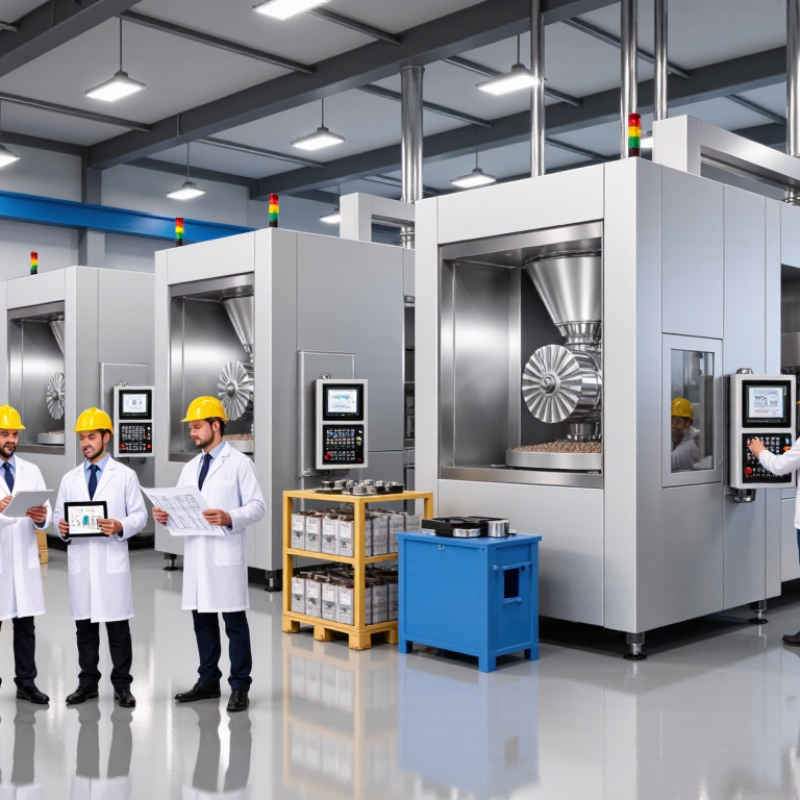
Top Granulation Machine Manufacturers for Global Buyers?

Granulation Machines: Types, Functions, and Industrial Applications

Granulation machines convert powders, liquids, or wet mixtures into uniform granules. Common types include wet granulators, dry granulators, oscillating granulators, and high-shear granulators. Each design handles different materials and production targets. Wet granulation uses a liquid binder to improve flow and reduce dust. Dry granulation compacts powder without added moisture. This matters when heat or water may damage the formulation.

In industrial production, granulators support pharmaceutical, food, chemical, fertilizer, and advanced material processing. Their functions include particle enlargement, dust control, improved flow, and more consistent filling. Operators often monitor rotor speed, screen size, feed rate, moisture, and discharge temperature. A small setting change can alter granule size significantly. In my experience, buyers sometimes focus on hourly capacity first. That can be a mistake. Product sensitivity, cleaning access, and maintenance time may matter more. Real production is less predictable than a catalog suggests.

Tips: Test the actual material before purchase. Ask for particle-size data, energy consumption, and cleaning procedures. Check whether contact parts suit the process environment. Confirm that operators can replace screens safely and quickly. Leave room for process variation. Perfect granules are not always realistic. A practical machine should deliver stable results, even when moisture or feed density changes slightly. Keep records during trials, because memory often misses the details that later affect scale-up.

Key Factors for Evaluating Granulation Machine Manufacturers

Top Granulation Machine Manufacturers for Global Buyers?

Key Factors for Evaluating Granulation Machine Manufacturers

Selecting a granulation machine manufacturer requires more than comparing prices. Buyers should examine experience with similar materials, production volumes, and target particle sizes. A supplier may claim high throughput, yet actual performance depends on moisture, binder behavior, feed consistency, and screen design. Request test data from materials close to yours. Ideally, review samples produced during a witnessed trial.

Engineering depth matters. Check whether the manufacturer can explain torque, heat generation, wear resistance, cleaning access, and process control. Ask for drawings, utility requirements, calibration records, and documented quality procedures. Reliable manufacturers provide clear specifications instead of vague promises. Their machines should support repeatable results across different batches. Small details matter.

Service capability deserves equal attention. Confirm spare-part availability, installation support, operator training, and response times across your region. Study references from facilities with comparable operating conditions. I have seen projects delayed because a minor seal was unavailable. That failure was avoidable. A factory visit can reveal practical discipline, including workshop cleanliness, inspection routines, and assembly standards. It may also expose weaknesses that brochures hide.

Cost should include energy use, maintenance labor, tooling replacement, downtime, and validation work. The cheapest quotation is rarely the lowest long-term cost. Still, no evaluation is perfect. Trial results can differ from daily production. Build acceptance criteria, performance guarantees, and service responsibilities into the contract. A careful buyer tests the machine, questions assumptions, and records every decision.

Leading Granulation Machine Manufacturers in Global Markets

Global buyers need more than a machine with impressive output figures. Leading granulation machine manufacturers serve different production environments, materials, and regional standards. Their equipment may support dry, wet, or fluid-bed granulation, depending on process goals. Experienced manufacturers ask about particle size, moisture, batch volume, and cleaning routines before suggesting a model. This practical consultation often prevents expensive redesigns. A polished catalogue cannot replace process knowledge. Not always.

Reliable manufacturers document critical specifications clearly. They explain motor capacity, contact materials, control systems, dust management, and expected maintenance intervals. They also provide factory testing, operating guidance, spare-part planning, and responsive technical support. For global markets, documentation should be available in clear technical English and adapted to local requirements. Quality systems, traceable components, and repeatable testing strengthen buyer confidence. Buyers should request sample trials when material behavior is uncertain. Small differences in moisture can change granule strength, flow, and drying time.

The strongest suppliers understand installation realities. They consider power supply, available floor space, ventilation, operator training, and shipping conditions. Remote support helps, but local service capacity still matters. A low purchase price may hide longer commissioning or difficult maintenance. Manufacturers should state these limits openly. Buyers also need to inspect references from comparable applications, not unrelated industries. No supplier is perfect. Even established producers may underestimate site constraints or cleaning time. Careful questions reveal more than broad promises, and honest answers are a useful sign of professional reliability.

Top Granulation Machine Manufacturers for Global Buyers? - Leading Granulation Machine Manufacturers in Global Markets
Machine Category Typical Process Common Capacity Range Typical Product Output Key Advantages Main Buyer Industries Important Purchase Criteria Common Global Compliance Considerations
High-Shear Wet Granulator Powder mixing followed by liquid binder addition and high-speed granulation. Laboratory to approximately 1,500 kg per batch, depending on bowl volume and formulation. Dense, uniform granules with good flowability and compressibility. Fast mixing Uniform granulation Good tabletability Pharmaceuticals, nutraceuticals, specialty chemicals, detergents. Impeller speed range, chopper design, binder spray system, cleaning access, batch containment. GMP design, hygienic construction, risk assessment, electrical safety, documentation for validation.
Fluid-Bed Granulator Fluidization, liquid spraying, granulation, and drying in a controlled airflow process. Laboratory units to approximately 1,000 kg per batch for industrial systems. Porous, lightweight granules with controlled residual moisture. Granulation and drying Efficient heat transfer Moisture control Pharmaceuticals, food ingredients, agrochemicals, ceramics, chemicals. Airflow uniformity, filter arrangement, spray nozzle performance, inlet-air control, explosion protection. GMP requirements, ATEX or equivalent dust-explosion controls where applicable, emissions management.
Dry Roller Compactor Powder densification between counter-rotating rolls, followed by milling and sizing. Approximately 5 to 2,000 kg per hour, depending on roll width, material, and compaction force. Dry, compacted ribbons or flakes that are milled into granules. No liquid binder No drying stage Suitable for moisture-sensitive powders Pharmaceuticals, minerals, fertilizers, chemicals, battery materials. Roll force, roll-gap control, feeder accuracy, ribbon density, milling system, dust containment. GMP documentation, dust-control provisions, machinery safety, explosion-risk evaluation.
Wet-Type Oscillating Granulator Wet mass is forced through a perforated screen using an oscillating rotor. Approximately 10 to 1,000 kg per hour, depending on screen size and material properties. Wet, relatively uniform granules prepared for subsequent drying. Simple operation Gentle sizing Replaceable screens Pharmaceuticals, food processing, chemicals, ceramics. Screen aperture, rotor configuration, feed consistency, product-contact materials, cleanability. Sanitary design, GMP-compatible contact surfaces, operator guarding, cleaning and inspection records.
High-Speed Comminuting Granulator Wet or dry material is reduced and sized using a high-speed rotor and screen. Approximately 20 to 1,500 kg per hour, depending on material hardness and screen selection. Controlled particle-size distribution for downstream processing. High throughput Flexible sizing Compact footprint Pharmaceuticals, chemicals, food ingredients, pigments. Rotor speed, screen area, temperature rise, vibration control, dust extraction, tool-free access. Machine guarding, dust management, hygienic design, noise and vibration controls.
Extrusion-Spheronization System Wet mass extrusion followed by rounding or spheronization of cylindrical extrudates. Approximately 1 to 500 kg per hour, depending on formulation and equipment configuration. Uniform spherical pellets with controlled size distribution. High pellet uniformity Controlled release applications Good coating performance Pharmaceuticals, agrochemicals, specialty chemicals, animal health products. Extruder pressure, die geometry, spheronizer speed, residence time, moisture control. GMP requirements, process validation, batch traceability, hygienic product-contact design.
Pan Granulator Powder is agglomerated in a rotating inclined pan while liquid binder or water is added. Approximately 50 to 10,000 kg per hour, depending on pan diameter and formulation. Rounded granules, often used where large-scale agglomeration is required. Large-scale operation Adjustable inclination Relatively simple maintenance Fertilizers, minerals, cement additives, chemicals, animal feed. Pan diameter, inclination angle, rotation speed, spray distribution, liner material, dust control. Industrial machinery safety, environmental dust controls, corrosion resistance, local electrical standards.
High-Pressure Briquetting or Compaction Granulator Powder is compacted under high pressure and subsequently crushed or screened into granules. Approximately 100 to 10,000 kg per hour, depending on material bulk density and compaction force. Dense granules, briquettes, or compacted flakes with improved handling properties. High densification Low moisture requirement Suitable for difficult powders Minerals, fertilizers, metallurgy, chemicals, biomass and industrial powders. Compaction pressure, roll or press design, feed consistency, wear resistance, downstream screening. Pressure-equipment risk assessment, guarding, dust control, electrical conformity, operator safety.
Buyer guidance: Capacity figures are typical industry ranges rather than guaranteed specifications. Actual performance depends on formulation, bulk density, moisture content, particle-size distribution, binder properties, target granule size, and process conditions. Global buyers should request material-specific trials, performance data, factory acceptance testing, spare-parts support, installation requirements, and validation documentation before placing an order.

Manufacturing Standards, Customization, and Quality Assurance

For global buyers, granulation machine quality begins with documented manufacturing standards. The 2022 ISO Survey recorded 1,265,216 ISO 9001 certificates worldwide. Certification alone proves little, however. Buyers should review audit records, material certificates, welding procedures, and calibration histories. Product-contact surfaces should match the process, such as polished stainless steel for pharmaceutical applications. Ask for measurable roughness values, not vague claims.

Customization should follow process evidence. A supplier needs your batch size, powder properties, moisture range, binder viscosity, and target granule size. The machine may require adjustable impeller speed, controlled spray pressure, or interchangeable screens. Factory acceptance testing should measure yield, temperature rise, cleaning time, and granule distribution. Small details matter. A poorly positioned spray nozzle can create wet lumps near the bowl wall.

Quality assurance also needs a lifecycle approach. FDA’s Process Validation Guidance describes three stages: process design, qualification, and continued verification. Request installation and operational qualification documents, software access controls, alarm tests, and spare-parts traceability. ISO 9001 does not guarantee successful scale-up. That remains a common weakness. Buyers should compare factory test results with site performance, because powder behavior can change after transport, humidity shifts, or operator adjustments. Independent sampling and repeat trials may expose problems earlier than polished sales documentation.

Top Granulation Machine Manufacturers for Global Buyers

Typical particle-size ranges by granulation technology: a practical benchmark for manufacturing standards, customization, and quality assurance.

Wet and high-shear granulation commonly produce controlled granules around 0.2–2.0 mm, while dry roller compaction can support broader size ranges of approximately 0.5–5.0 mm. Fluid-bed granulation is often selected when narrower particle-size control and integrated drying are required. Actual results depend on formulation, screen size, process settings, and validation requirements.

Representative engineering ranges based on commonly specified pharmaceutical and industrial granulation processes; they are not company-specific performance claims.

Purchasing, Installation, and After-Sales Support Considerations

Buying a granulation machine requires more than comparing hourly capacity. The International Energy Agency reports that industry consumes about 37% of global final energy. Therefore, buyers should request verified motor efficiency, load profiles, and realistic power consumption. Ask for trials using your actual feedstock. Particle size, moisture, bulk density, and contamination can change performance sharply.

Installation planning should cover floor loading, ventilation, dust control, electrical standards, and spare-part access. A small clearance mistake can delay commissioning. The U.S. Department of Energy notes that compressed-air leaks may waste 20–30% of compressor output, making pneumatic systems worth auditing early. Require a documented factory acceptance test, installation checklist, operator training, and site acceptance criteria. Keep the language measurable. “High efficiency” is not enough.

After-sales support often determines long-term value. A 2024 Deloitte manufacturing survey found that many manufacturers still struggle with skilled-worker shortages, so remote diagnostics and practical training deserve attention. Request response-time commitments, recommended spare inventories, maintenance intervals, and local service coverage. Ask whether software updates remain available after warranty expiration. That detail is frequently missed. Buyers should also review the service history of similar installations, not only polished references. No supplier is perfect. The better question is how clearly it reports failures, corrective actions, and recurring maintenance costs. These records create more trust than optimistic promises. (Sources: IEA, Energy Efficiency 2023; U.S. DOE, Improving Compressed Air System Performance; Deloitte, 2024 Manufacturing Industry Outlook)

CONTACT US