
What Are the Top Types of Material Handling Robots in 2026?
Material Handling Robots are no longer confined to fenced production cells. In 2026, warehouses and factories use mobile robots, robotic arms, palletizers, and automated storage systems to move goods through busy work areas. Each type solves a different problem. A mobile robot may carry a tote across a warehouse, while a palletizing arm stacks cartons beside a conveyor.
Joseph Engelberger, an industrial robotics pioneer, famously said, “I can’t define a robot, but I know one when I see one.” His line captures a practical challenge: robot categories can overlap. An autonomous mobile robot and an automated guided vehicle may look similar, yet differ in how they navigate and adapt to obstacles. That distinction matters.
This guide examines the top types of Material Handling Robots and the work each performs. It compares their typical roles, strengths, and trade-offs, from case picking to pallet movement. The right choice depends on more than speed. A narrow aisle, changing product mix, or uneven floor can alter the calculation. Sometimes, a simple system is the better fit. No robot fixes a poorly planned workflow on its own. These details deserve a closer look before any 2026 investment.
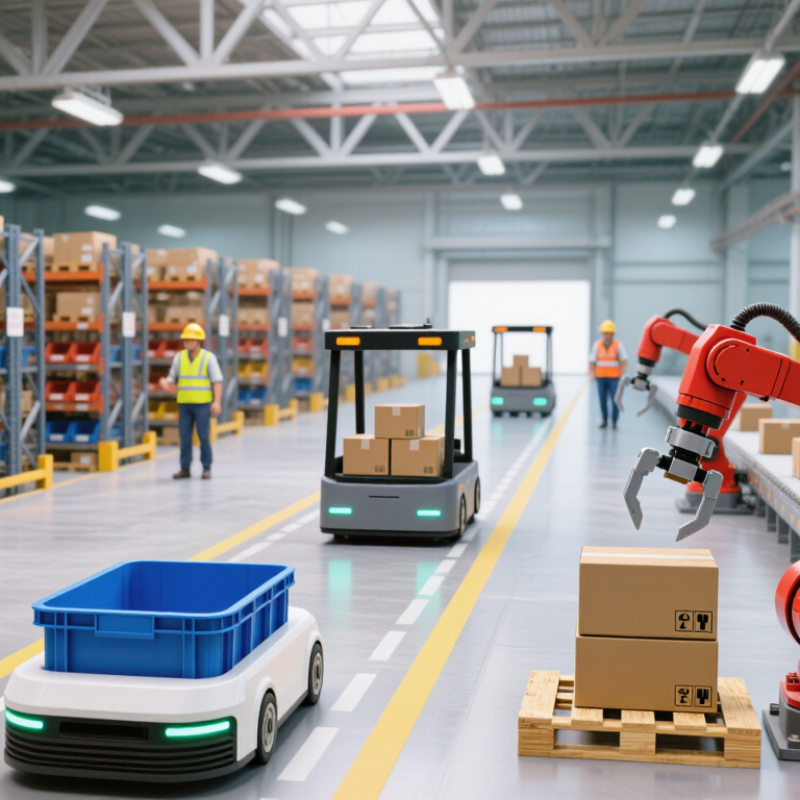
How Material Handling Robots Are Classified in 2026
In 2026, material handling robots are most useful to classify by mobility, task, and payload. Appearance alone can be misleading. Automated guided vehicles (AGVs) typically follow mapped or marked routes, while autonomous mobile robots (AMRs) use sensors to navigate changing spaces. Both can move totes or pallets, but their route flexibility and facility requirements differ.
A second category is fixed industrial robots, including articulated arms and gantry systems. They handle repeatable tasks such as picking, sorting, machine loading, and palletizing. Their reach, gripper type, and load capacity matter as much as the task name. A robot lifting cartons from a conveyor needs different tooling from one placing heavy bins onto a pallet. The distinction matters.
Collaborative robots form another classification, based on how people and machines share work areas. This label describes an operating approach, not a separate handling task; a collaborative arm may still pick, pack, or load. In real facilities, categories overlap. An AMR can carry a mobile robot arm, for example. That makes neat labels imperfect, so compare systems by payload, cycle time, navigation method, safety controls, and the exact handoff points in a workflow. A clear floor plan helps. Robots still need sensible exceptions for blocked aisles, mixed loads, and imperfect scans.
What Are the Top Types of Material Handling Robots in 2026? — How Material Handling Robots Are Classified
| Robot Type | How It Is Classified | Typical Material-Handling Tasks | Movement and Navigation | Key Advantages | Common Considerations |
|---|---|---|---|---|---|
| Autonomous Mobile Robot (AMR) | Mobile robot that can perceive its surroundings and plan or adjust routes using onboard sensors and software. | Moving totes, carts, components, and work-in-process between storage, production, and packing areas. | Travels along routes that can be changed dynamically; may reroute around obstacles when the system permits. | Flexible routes and workflows; often suitable for facilities where layouts or traffic patterns change. | Requires careful traffic planning, suitable floor conditions, charging arrangements, and integration with task-management systems. |
| Automated Guided Vehicle (AGV) | Mobile robot that follows a defined route or guidance system, such as floor markings, reflectors, wires, or mapped paths. | Repeatable transport of pallets, bins, or carts along established routes. | Typically follows a preconfigured path and may pause or stop when its route is obstructed. | Well suited to stable, repetitive transport flows with predictable pickup and drop-off points. | Route changes and blocked pathways can require operational adjustments or system reconfiguration. |
| Autonomous Forklift | Mobile material-handling vehicle with automated navigation and a lifting mechanism for palletized loads. | Picking up, transporting, and placing pallets; some systems also serve racks, conveyors, or production lines. | Moves through warehouse or factory aisles and uses sensing and positioning systems to approach loads and storage locations. | Combines pallet transport and lifting in one vehicle, reducing some routine forklift movements. | Needs suitable aisle widths, accurate load presentation, safety controls, and coordination with people and other vehicles. |
| Articulated Robotic Arm | Stationary manipulator with rotary joints; commonly classified by its joint arrangement and number of axes. | Machine tending, picking and placing, case packing, palletizing, and transferring parts between stations. | Moves its end effector through a three-dimensional work envelope around a fixed base. | Offers a broad working range and can handle varied movements with an appropriate end effector. | Reach, payload, cycle time, tooling, guarding, and the layout of nearby equipment must match the task. |
| SCARA Robot | Selective-compliance arm, usually designed for fast movement in a horizontal plane with vertical-axis motion. | Small-part transfer, component insertion, sorting, and assembly-line pick-and-place operations. | Works mainly within a horizontal workspace, with vertical movement for pickup and placement. | Can provide fast, repeatable handling for compact tasks arranged around a workstation. | Its working envelope and motion are less suited to tasks requiring broad, flexible three-dimensional reach. |
| Cartesian / Gantry Robot | Linear-axis robot that moves along two or three orthogonal axes; a gantry version is typically supported by an overhead frame. | Loading and unloading, palletizing, large-area pick-and-place, and moving products between fixed stations. | Moves in straight lines along X, Y, and, in many systems, Z axes. | Provides a predictable rectangular work area and can cover large spans when supported by an appropriate structure. | Requires space for rails or a frame and may be less adaptable to obstacles or irregular workspaces. |
| Collaborative Robot (Cobot) | Robot arm designed for applications where people and robots may share a workspace under a task-specific safety assessment. | Part loading, light assembly, bin picking, packing, and repetitive transfer tasks near human workstations. | Usually mounted at a workstation and programmed to perform a defined sequence; some applications use hand-guided setup. | Can be easier to redeploy between tasks than some fixed automation installations. | Collaborative design does not make every application inherently safe; risk assessment, tooling, speed, and workspace conditions matter. |
Classification note: These categories are based on mobility, navigation, or mechanical structure, so they can overlap. For example, a palletizing application may use an articulated arm or a gantry robot, while a mobile robot may carry a conveyor or other load-handling attachment.