
Top 10 Pastry Maker Manufacturers for Global Buyers

Global buyers choosing a Pastry Maker manufacturer need more than an attractive catalog. Production volume, pastry type, available floor space, cleaning routines, and after-sales support all shape the right choice. A compact countertop unit may suit a café; a high-capacity machine needs dependable parts and service. Small details matter. A tray that fits poorly can slow an entire shift.

Demand provides useful context, but it should not be confused with equipment sales. Grand View Research’s Bakery Products Market report estimated the global market at approximately USD 480 billion in 2023 and projected continued growth through 2030. This figure covers baked goods, not Pastry Maker machines. Still, it points to a broad market where consistent output and efficient production matter. Buyers should compare specifications against their own recipes and workloads, rather than treating market growth as proof that any machine will pay off.

Julia Child, the culinary expert, is widely attributed with saying, “A party without cake is just a meeting.” The line captures pastry’s appeal, though it says little about machine performance. That is where careful evaluation begins. This guide compares 10 manufacturers for global buyers, focusing on product range, operating capacity, customization, documentation, and support. Check these claims directly with each supplier. A polished brochure cannot confirm how a machine handles your dough on a busy morning.
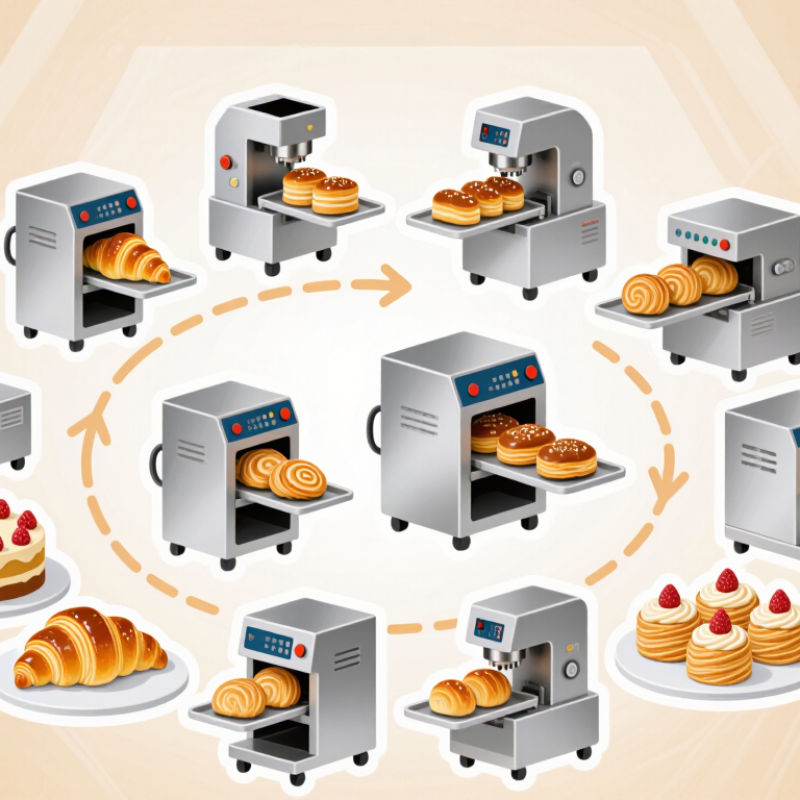
Top 10 Pastry Maker Manufacturers for Global Buyers

Defining Pastry Maker Equipment and Its Commercial Uses

Pastry maker equipment covers the machines that turn dough, batter, and fillings into consistent commercial products. A production line may include spiral mixers, dough sheeters, portioning depositors, proofers, ovens, cooling conveyors, and finishing tools. Smaller operations may use only a mixer, bench sheeter, and oven. The right setup depends on product shape, batch size, and available floor space.

The equipment supports croissants, Danish pastries, tarts, cookies, and filled pastries. Sheeters control dough thickness; depositors portion filling; proofers manage temperature and humidity before baking. A few millimeters can change a laminated pastry’s lift. Cleanable surfaces and accessible guards also matter during daily changeovers. They are easy to overlook when comparing machine speeds.

Grand View Research’s bakery processing equipment report estimates a global market value of about US$11 billion in 2023 and projects continued growth through 2030. That scale reflects demand for repeatable output, not a single ideal machine. Buyers should compare hourly capacity with real product and changeover needs. A fast line can still create waste if its portions, temperatures, or cooling times do not suit the recipe. There is no shortcut here. Manufacturers’ specifications help, but production trials reveal more.

Key Criteria for Evaluating Manufacturers for Global Buyers

For global buyers comparing pastry maker manufacturers, judge the equipment and the support behind it. Ask for documented capacity at your actual dough weight, product size, and production speed—not a best-case demonstration. Check whether stainless-steel contact surfaces are easy to inspect and clean, and request food-safety procedures aligned with the Codex General Principles of Food Hygiene, which recommend hazard analysis and preventive controls. Also verify electrical requirements, spare-parts lead times, operator training, and service coverage in your region. A low purchase price can become costly when a small belt or temperature sensor takes weeks to replace.

Energy use deserves a practical test. The U.S. Environmental Protection Agency reports that qualifying commercial ovens use about 20% less energy than conventional models. Treat this as a benchmark, not a guaranteed saving for every pastry line. Request measured consumption under comparable loads, then check temperature recovery after repeated door openings. Ask for noise levels and cleaning time, too. These details rarely appear in glossy brochures. They matter on a hot production floor.

Tips: Request a factory acceptance test using your own recipe, including a batch with delicate filling. Record output, reject rate, and changeover time. Keep the test conditions in writing. One limitation: a short trial may not reveal wear after months of daily use, so ask for maintenance records and references from similar facilities. Conversely, references can be selective; weigh them alongside service data and written warranty terms.

Top 10 Pastry Maker Manufacturers for Global Buyers

Key criteria for evaluating manufacturers

This suggested 100-point weighting helps buyers compare manufacturers consistently. It is a procurement framework, not a survey or ranking of specific companies. Verify food-safety requirements, relevant certifications, production capacity, and service commitments for each purchase.

Profiles of Ten Pastry Maker Manufacturers

The ten profiles below describe common pastry-maker capabilities, not named companies or verified rankings. An artisan-focused manufacturer often works in small batches, with hand-finished edges and seasonal fillings. Built for detail. A high-volume producer prioritizes consistent sizing, automated forming, and steady output for retail orders. A frozen-dough specialist designs products for controlled storage and predictable baking. Buyers should check thawing instructions and test samples in their own ovens. A laminated-pastry maker focuses on dough layers, butter distribution, and proofing control. Ask how these are monitored. A filled-pastry producer may offer fruit, custard, or savory centers, where filling weight and seal quality matter.

Other profiles include a regional-recipe maker, whose products reflect local ingredients; a premium patisserie supplier, focused on delicate finishes; and a private-label manufacturer, able to adapt recipes and packaging to buyer specifications. A plant-based specialist develops recipes without dairy or eggs, but texture can vary between batches. A custom-batch producer handles unusual shapes or limited runs, often with longer lead times. Finally, an automation-led manufacturer may provide strong repeatability, though less flexibility for intricate designs. These distinctions are useful starting points, not proof of quality. Request current product specifications, ingredient and allergen information, production capacity, sample batches, and relevant food-safety documentation. Compare like with like. A polished catalogue alone cannot show how a pastry performs after transport, storage, and baking.

Top 10 Pastry Maker Manufacturers for Global Buyers — Profiles of Ten Pastry Maker Manufacturers
Profile Main Equipment Focus Common Configuration Best-Fit Buyer Key Selection Checks Export and Service Considerations
Profile 1: Artisan Bakery Specialist Dough mixers, pastry sheeters, proofers, and compact ovens Small-batch equipment with manual or semi-automatic controls Independent bakeries and pastry shops producing varied daily menus Working width, dough capacity, cleaning access, and ease of changing settings Confirm voltage, plug type, operator training, spare-parts availability, and local service coverage
Profile 2: Laminated-Dough Line Supplier Dough sheeting, laminating, and pastry-line equipment Standalone sheeters or connected production-line sections Businesses making croissants, Danish pastries, and other laminated products Roller adjustment range, line speed, dough handling, footprint, and cleaning procedures Request installation requirements, line-layout drawings, commissioning terms, and remote support details
Profile 3: Cookie and Biscuit Equipment Builder Dough mixers, depositors, wire-cut machines, and forming equipment Production equipment selected to match dough type and product shape Commercial bakeries making cookies, biscuits, or short pastries in repeat batches Depositing or cutting method, changeover time, product consistency, and food-contact materials Check documentation for electrical and machinery compliance in the destination market
Profile 4: Pie and Tart Production Specialist Pastry presses, dough sheeters, moulding equipment, and filling depositors Separate forming and filling machines or a coordinated line Manufacturers producing pies, tart shells, and filled pastry products Compatible mould sizes, filling accuracy, product release, and cleanability Verify mould supply, spare tooling lead times, packaging dimensions, and after-sales arrangements
Profile 5: Industrial Bakery Line Integrator Automated dough preparation, forming, conveying, and baking systems Configured lines built around required products, capacity, and factory layout Large bakeries and food manufacturers seeking integrated production Line capacity, process compatibility, controls integration, utilities, and factory footprint Confirm project scope, site-survey requirements, installation schedule, training, and service response terms
Profile 6: Frozen-Pastry Equipment Specialist Forming, proofing, baking, and handling equipment for frozen or chilled products Equipment arranged to suit the buyer’s production and cold-chain process Suppliers of frozen pastries to retail, food service, or regional distribution networks Product condition at each process stage, freezer interfaces, sanitation, and process repeatability Review temperature-related operating requirements and confirm the supplier’s commissioning support
Profile 7: Bakery Oven Manufacturer Deck, rack, and convection ovens for pastry production Oven type and chamber arrangement selected for product mix and baking workflow Operations replacing ovens or adding baking capacity Tray compatibility, chamber size, temperature control, energy source, and loading method Check local fuel or electrical requirements, ventilation needs, emissions rules, and service access
Profile 8: Depositing and Filling Equipment Supplier Depositors and filling systems for creams, batters, and pastry fillings Manual, semi-automatic, or automated dispensing configurations Pastry producers needing repeatable portioning or filling operations Product viscosity range, portion size, nozzle options, accuracy, and cleaning method Ask about product trials, change parts, food-contact declarations, and operator training
Profile 9: Bakery Automation and Handling Specialist Conveyors, tray handling, cooling, and production-line automation Modules integrated with existing or new bakery equipment Factories aiming to reduce manual handling or connect separate process stages Interface compatibility, line speed, available floor space, guarding, and cleaning access Request integration responsibilities, technical drawings, safety documentation, and maintenance guidance
Profile 10: Custom Bakery Machinery Builder Special-purpose pastry forming and production machinery Equipment engineered around product samples, process requirements, and site constraints Buyers with a distinctive product or a process not covered by standard machines Prototype and trial process, acceptance criteria, production repeatability, and tooling ownership Agree on specifications, inspection milestones, documentation, warranty scope, and delivery terms in writing

Buyer note: These are anonymized equipment-manufacturer profiles, not named or ranked company listings. Configurations and performance vary by machine and supplier; verify specifications, certifications, references, and service capability directly before purchasing.

Comparing Product Ranges, Capacity, and Automation

A useful comparison of pastry-maker manufacturers starts with product range, not a headline speed. Check whether one supplier can handle mixers, sheeters, depositors, ovens, cooling, and line integration. Then compare stated capacity in units per hour, while asking which pastry size, recipe, and operating shift produced that figure. A line rated for 6,000 pieces per hour may deliver less after filling changes or frequent cleaning. Details matter.

Automation is expanding across manufacturing, but broad figures are not pastry-line guarantees. The International Federation of Robotics’ World Robotics 2024 report recorded 541,302 industrial robot installations worldwide in 2023. Deloitte’s 2024 smart-manufacturing survey found that 86% of surveyed manufacturers viewed smart manufacturing as a competitiveness driver over the next five years. These figures support asking about robotic tray loading, recipe controls, and machine monitoring. They do not prove a specific pastry line will pay back quickly.

Ask manufacturers for a product-by-product capacity sheet and a live demonstration using your dough and filling. Watch how operators clear a jam, switch recipes, and keep delicate layers intact. Small details expose weak spots. Compare changeover time, waste rates, spare-parts access, and the number of skilled operators required. A wider product range can mean useful flexibility, or extra complexity. I would treat quoted output as a starting point, not a promise; real production conditions are rarely so tidy.

Global Purchasing Factors: Compliance, Service, and Supply

Global buyers evaluating pastry-making equipment should treat compliance as a documented process, not a catalogue claim. Ask for material declarations, cleaning instructions, electrical test records, and traceability for parts that contact dough or filling. Requirements differ by destination, so confirm which documents local importers and inspectors need before production begins. Details matter. The World Health Organization estimates that unsafe food causes 600 million illnesses and 420,000 deaths each year. That figure concerns food safety broadly, but it underlines why hygienic design and clear cleaning procedures deserve close review.

Service quality is easiest to assess through specifics. Request response-time targets, remote troubleshooting steps, technician coverage, and a parts list with lead times. A machine may perform well during factory acceptance testing yet lose value if a small forming component takes weeks to replace. Ask for training materials in the operators’ working language, too. Promises are not enough.

Supply planning needs the same scrutiny. UNCTAD’s Review of Maritime Transport 2024 notes that shipping carries over 80% of world trade by volume, making transport disruptions relevant to equipment schedules and spare parts. Buyers should compare quoted lead times with shipping routes, packaging plans, and available substitute components. Still, forecasts can be wrong. I would treat a supplier’s delivery estimate as a planning input, not a guarantee, and record how delays are communicated.

CONTACT US