Why Should Businesses Invest in AI Robots?
An Ai Robot can do more than repeat a programmed motion. In a warehouse, it may move totes between shelves while staff handle exceptions. On a production line, it can maintain a steady inspection routine under changing shifts. These systems combine sensing, software, and mechanical action, but their value depends on the task. A robot that looks impressive in a demonstration may still struggle with clutter, downtime, or awkward handoffs.
AI researcher Andrew Ng, a Stanford professor and co-founder of Google Brain, has called AI “the new electricity.” The comparison helps explain why businesses are exploring Ai Robot systems: the technology may support many workflows, but each use needs practical evaluation. A useful investment case starts with one measurable problem, such as reducing repetitive lifting or improving inspection consistency. It should also account for integration, staff training, maintenance, and safety procedures. Those costs are easy to underestimate.
That sounds tidy. Real deployments are messier. A pilot should record baseline performance, interruptions, repair time, and worker feedback—not just units moved per hour. Managers can then compare results with the cost of ownership and decide whether expansion makes sense. Some tasks may not justify automation. Others may become worthwhile as processes improve. The strongest business case is rarely “robots are the future.” It is a clear, tested reason why this Ai Robot fits a specific operation today.
What AI Robots Are and How They Operate
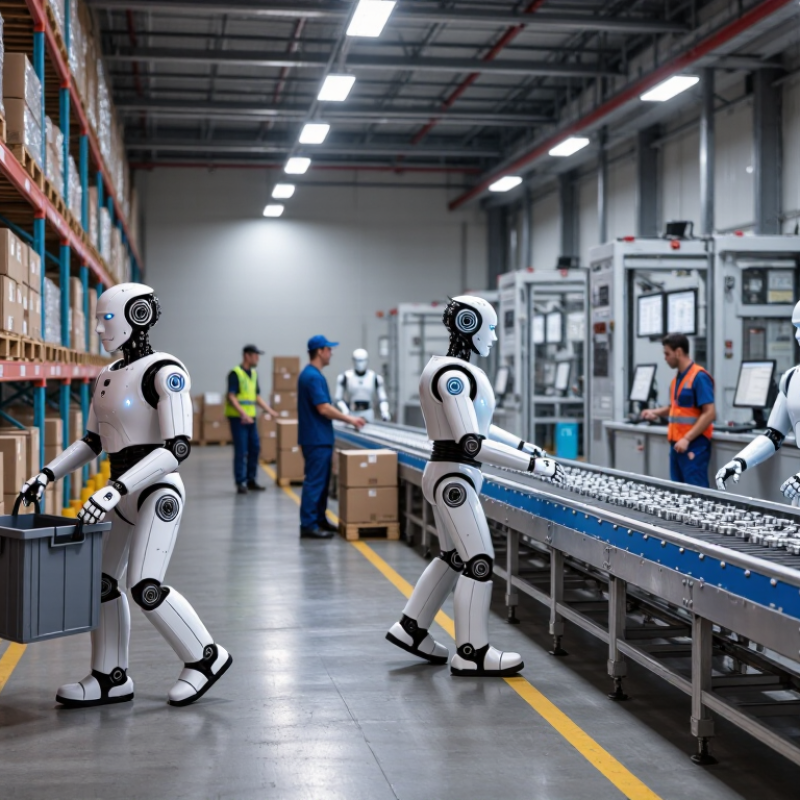
AI robots are machines that sense their surroundings, interpret information, and act in the physical world. A warehouse model might use cameras and depth sensors to locate a carton, plan a route, then adjust when a person crosses its path. Its AI may recognize objects or predict movement; motors, grippers, and control software turn those decisions into motion. The process is a loop: sense, decide, act, and check. Not magic.
Some robots rely on fixed instructions, while AI-enabled systems can handle more variation and improve from new data. They still need boundaries: engineers set speed limits, safe zones, and rules for uncertain situations. A useful robot should also make its status visible, such as showing a fault light or requesting human help. In practice, messy lighting or an unfamiliar object can still cause mistakes.
Adoption is growing, though growth alone does not prove that every task needs a robot. The International Federation of Robotics reported 4,281,585 industrial robots operating worldwide at the end of 2023, up 10% year over year, in World Robotics 2024. Its World Robotics 2024 Service Robots report also recorded nearly 205,000 professional service robot units sold in 2023, a 30% increase. These figures describe different categories, not a guarantee of productivity. A careful trial should measure cycle time, error rates, and human workload in the actual work area. Sometimes the best answer is a simpler tool.
Where Businesses Use AI Robots
Why Should Businesses Invest in AI Robots?
Where Businesses Use AI Robots
AI robots are most useful where work is repetitive, physically demanding, or dependent on frequent data collection. In warehouses, mobile robots can move boxes between storage areas and packing stations. Cameras and sensors help them avoid obstacles, while staff handle unusual orders or crowded aisles. Small gains matter.
Factories use robotic arms to inspect parts, move materials, and perform consistent assembly steps. A vision system might flag a scratched surface before a product reaches shipping. These systems can reduce routine strain, but they still need maintenance and human oversight. A poorly placed robot may slow the line instead of improving it.
Hospitals and care facilities use robots to deliver supplies, transport meals, or disinfect rooms. They do not replace clinical judgment or human care. Retail businesses may use robots to scan shelves and identify empty spaces, while farms can use them to monitor crops and target watering. The right application depends on the building, staff, and task. It depends.
Businesses should test robots in a limited area, measure actual time savings, and ask workers what has become harder. A clean demonstration is not the same as a busy Tuesday.
How AI Robots Can Improve Business Performance
AI robots can improve business performance by taking on repetitive, time-sensitive work. In a warehouse, a mobile robot might move sealed cartons between picking stations while staff handle exceptions. On a production line, vision systems can flag uneven labels before products reach packing. Small gains add up. Teams may spend less time walking, sorting, or checking the same item twice.
Consistency matters. A robot can follow a defined route through a shift, record cycle times, and alert staff when a process slows. These records help managers spot bottlenecks instead of relying only on rough estimates. In customer operations, AI systems can sort routine requests so employees have more time for cases that need judgment. The benefit is practical, not magical.
Results depend on fit. A poorly chosen robot can add delays, maintenance costs, and new training demands. The first weeks can feel awkward. Businesses should compare a small pilot with a clear baseline, such as orders packed per hour or defects per batch. They should also ask workers where the process breaks down; a neat dashboard may miss a blocked aisle or an unusual product. Even with good data, some improvements take longer than expected.
Why Should Businesses Invest in AI Robots? — How AI Robots Can Improve Business Performance
Global industrial robot installations, 2018–2023
Global industrial robot installations rose from 422,000 in 2018 to 541,000 in 2023, showing sustained business investment in automation. Robots can support productivity by handling repetitive tasks and operating consistently; these figures cover industrial robots overall, not AI-enabled robots alone.
Source: International Federation of Robotics (IFR), World Robotics 2024. Installations are rounded to the nearest thousand.
Costs, Risks, and Workforce Considerations
Why Should Businesses Invest in AI Robots?
Costs, Risks, and Workforce Considerations
The purchase price is only the visible part of an AI robot’s cost. Businesses must also budget for integration, safety equipment, maintenance, software updates, and staff training. A robot may need a redesigned workcell or reliable data before it can perform consistently. Measure the full lifecycle cost against practical results: cycle time, error rates, downtime, and worker workload. Small pilot, clear baseline. Even then, forecasts can be wrong; unusual products and changing demand often expose hidden costs.
Scale is growing: the International Federation of Robotics reported 541,302 industrial robot installations worldwide in 2023, with 4.28 million robots operating in factories. Yet adoption brings risks, including unsafe handoffs, biased outputs, and failures when inputs change. The NIST AI Risk Management Framework recommends mapping, measuring, and managing AI risks throughout deployment.
Workforce planning matters, too. The World Economic Forum’s Future of Jobs Report 2025 projects 170 million jobs created and 92 million displaced globally by 2030; these figures cover broad labor-market shifts, not robots alone. Train operators to supervise systems, spot faults, and stop work when behavior looks unsafe. Some tasks will change, and not every worker will welcome that. That discomfort deserves attention.
How to Assess and Implement AI Robots
Why Should Businesses Invest in AI Robots? How to Assess and Implement AI Robots
Assess the task before choosing a robot. Map one work cell: note cycle times, handoffs, stoppages, and the awkward cases workers handle by eye. The International Federation of Robotics reported 4,281,585 industrial robots operating worldwide in 2023, up 10% from 2022. This shows the scale of industrial automation, not the number of AI robots. Start small. Choose a repeatable task where errors, delays, or physical strain can be measured. Set a baseline for throughput, downtime, defect rates, and maintenance costs before running a pilot. If the baseline is fuzzy, the business case will be too.
During the pilot, test the robot against real operating conditions: changing lighting, mixed products, and occasional misaligned parts. Check how it connects with existing equipment, who reviews exceptions, and whether staff can maintain it safely. Define success thresholds in advance, including a stop condition if performance or safety falls short. The IFR’s World Robotics 2024 report is useful context, but broad adoption figures cannot predict returns at a specific site. Track results over enough shifts to capture variability. A neat demo is not proof. AI systems may still need human review, retraining, or process changes; those costs are easy to underestimate. A staged rollout, with worker feedback and documented performance checks, can reveal problems before expansion.