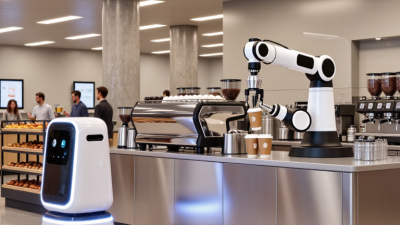
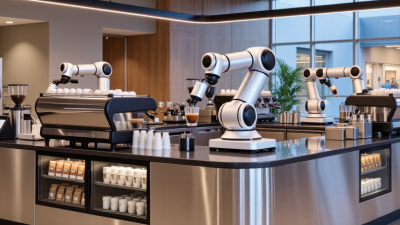
7 Coffee Robot Buying Tips for Global Buyers

Coffee Robot purchasing is no longer a novelty decision. It is an operational investment involving speed, consistency, labor, maintenance, and customer trust. Global buyers must inspect the machine behind the polished touchscreen.

The International Federation of Robotics reported 541,000 industrial robots were installed worldwide in 2023. This figure shows strong automation momentum, but it does not measure coffee robots directly. That distinction matters. The International Coffee Organization also highlights rising pressure on coffee value chains, including cost control, resilience, and quality protection. A reliable Coffee Robot should therefore fit real service conditions, not merely perform well in a showroom.

Henry Hu, founder of Cafe X, described the company’s approach this way: “The robot is not the product; the coffee is the product.” The principle is simple. Buyers should test espresso temperature, milk texture, cleaning time, payment integration, and recovery after errors. Watch the machine during a crowded morning. Listen for unusual noise. Check whether staff can solve a jam without calling overseas support.

Some details remain easy to underestimate. A compact robot may require heavy electrical capacity, filtered water, stable internet, and trained operators. It may also struggle with menu changes or irregular cup sizes. I would not trust a sales brochure alone. Published industry statistics are useful, but they rarely reveal downtime, rejected drinks, or local service quality. The following seven buying tips connect market evidence with practical testing, helping global buyers choose equipment that performs beyond the demonstration counter.

7 Coffee Robot Buying Tips for Global Buyers

Define Your Coffee Robot Needs and Service Goals

Before buying a coffee robot, define the job it must perform. Will it serve office staff, hotel guests, commuters, or customers in a busy café? Record peak demand, drink types, cup sizes, and available floor space. A machine serving 80 cups daily needs different capacity from one serving 300.

Watch the workflow, not just the machine. Measure preparation time, refill frequency, cleaning steps, and staff involvement. A compact robot may look efficient, yet frequent syrup or milk refills can interrupt service. In one early planning exercise, I focused too much on speed and underestimated cleaning time. That mistake changed the equipment requirements.

Service goals should be measurable. Set targets for average serving time, drink consistency, uptime, and acceptable maintenance delays. Ask who will respond to faults at 8 a.m. on a Monday. Confirm training, spare-part access, remote support, warranty coverage, and local technician availability. These details often determine the real cost of ownership.

Leave room for human judgment. Customer preferences change, and menus rarely stay fixed. Choose a system that allows recipe adjustments without complicated technical work. Document daily checks, sanitation records, and escalation procedures. Reliable operation depends on disciplined routines, not impressive demonstrations alone. Test the robot during realistic rush periods before placing a large order. A quiet showroom cannot reveal every service problem.

Compare Robot Types, Features, and Automation Levels

7 Coffee Robot Buying Tips for Global Buyers

Compare the robot type before comparing its price.

A robotic arm suits back-bar tasks, such as dosing, tamping, and cup placement.

An automated kiosk fits compact sites with predictable menus.

A mobile robot serves tables but needs wider paths and stronger safety controls.

According to the International Federation of Robotics, 541,302 industrial robots were installed worldwide in 2023. This figure shows growing automation, not automatic suitability for coffee service.

Check seven practical points:

drink consistency brewing speed cleaning access ingredient capacity software integration service support local compliance

A semi-automatic system may leave extraction and milk texture to trained staff. A fully automatic unit reduces labor variation but can produce limited recipes.

Watch the grinder, steam system, sensors, and payment interface during a live test. Small delays become visible at a busy counter. Very visible.

The International Coffee Organization’s 2024 Coffee Report and Outlook estimated global consumption at 177.9 million 60-kilogram bags in 2023/24.

Demand is substantial, but volume alone should not determine the purchase. Compare output during peak periods, not only showroom demonstrations. Measure cleaning time with real staff.

Also check language support, spare-part access, electrical standards, and data protection rules in each destination.

I have seen buyers overvalue robotic speed and undervalue maintenance space. That mistake is easy to repeat.

A thoughtful pilot may reveal that a simpler robot serves customers better.

Evaluate Capacity, Coffee Quality, and Operating Performance

For global buyers, capacity should reflect real queue pressure, not a showroom’s fastest cycle. The International Coffee Organization estimated global coffee consumption at 177.9 million 60-kilogram bags in 2023/24. Demand is substantial, but local peaks matter more. Measure cups per hour during breakfast and lunch surges. Record brewing time, recovery time, refill frequency, and cleaning minutes. A machine producing 80 cups hourly may struggle if its water tank needs frequent replacement. Ask for test logs, not optimistic claims. Test it.

Coffee quality requires measurable controls. Specialty Coffee Association brewing guidance commonly uses water temperatures near 92–96°C and extraction yields around 18–22%. Buyers should verify temperature stability, dose accuracy, grind consistency, and beverage weight. Compare the first cup with the fiftieth. Taste matters. Also inspect milk texture, espresso crema, and drink temperature after a short queue. A visually impressive robot can still serve uneven coffee when ingredients warm or grinders drift.

Operating performance includes uptime, fault recovery, sanitation, and remote diagnostics. The International Federation of Robotics reported about 205,000 professional service robots sold globally in 2023, showing wider automation adoption. However, adoption does not guarantee reliable coffee service. Request documented uptime, average repair response, spare-part availability, and energy consumption. Calculate labor savings against cleaning and maintenance costs. My checklist still cannot predict every site problem. Floor space, unstable connectivity, and unfamiliar staff may expose weaknesses. Pilot testing in the target location remains essential.

Check Global Compliance, Installation, and After-Sales Support

7 Coffee Robot Buying Tips for Global Buyers

Global compliance should be checked before comparing prices. Ask for electrical safety, electromagnetic compatibility, food-contact, and radio documentation for the destination market. Requirements differ across regions. For example, the EU Machinery Regulation 2023/1230 introduces updated machinery obligations, while RoHS controls restricted substances in electrical equipment. A qualified local assessor should review the technical file. Do not rely on a supplier’s generic certificate. The International Federation of Robotics reported 541,302 industrial robots were installed worldwide in 2023, showing the scale of automation, but coffee equipment still needs application-specific verification.

Installation planning is equally practical. Confirm voltage, frequency, water pressure, drainage, ventilation, floor clearance, and network access before shipment. A small café may have no dedicated drain or stable Wi-Fi. That detail can stop production. Request drawings, utility limits, commissioning steps, and operator training in writing. Energy use also deserves attention; the International Energy Agency reports that buildings account for about 30% of global energy demand. A robot with high standby consumption may weaken operating margins over time.

After-sales support should be measured, not promised. Request response-time targets, spare-parts availability, software-update policies, and escalation contacts. Keep critical parts locally when possible. A 48-hour reply is not the same as a 48-hour repair. This distinction is often missed. The Service Council’s field-service research consistently links first-time-fix performance with customer satisfaction, yet buyers rarely demand this metric during tendering. One imperfect assumption is expecting remote support to solve every fault. Water quality, calibration, and cleaning still require trained people on site.

Calculate Total Cost, ROI, and Supplier Reliability

Buying a coffee robot is not only a hardware decision. For global buyers, the real question is whether the machine earns its place. Start with total cost, not the advertised purchase price. Include shipping, import duties, installation, training, software, maintenance, spare parts, and electricity. A machine priced at $18,000 may require another $6,000 before serving its first customer. Ask for a five-year cost sheet. Then check local service coverage and response times.

Estimate daily orders using realistic foot traffic, not the supplier’s best-case projection. If one drink sells for $4.50 and variable costs reach $1.40, gross contribution is $3.10. At 80 drinks per day, monthly contribution may approach $7,440 before rent and labor. Use conservative assumptions. Subtract downtime and seasonal demand. ROI should show payback time, maintenance risk, and an alternative use for the capital. My first forecast ignored weekend demand swings. It looked precise, but it was wrong. Build three cases: cautious, expected, and strong.

Supplier reliability needs evidence. Request installation records, uptime data, warranty terms, and references from comparable markets. Check whether critical parts are stocked near your operating region. A remote technician cannot repair an empty grinder shelf. Ask who owns the software account and what happens if connectivity fails. Require acceptance testing for drink temperature, recipe accuracy, cleaning time, and payment security. Do not accept vague promises. Contracts should define service levels, replacement timelines, training hours, and data access. One uncomfortable question matters: what has failed for previous customers, and how was it fixed?

7 Coffee Robot Buying Tips for Global Buyers - Calculate Total Cost, ROI, and Supplier Reliability

Buying Tip Key Data Dimension Practical Benchmark or Example Calculation Method Due-Diligence Check Recommended Buyer Action
1 Calculate the complete 3-year cost Acquisition cost, logistics, installation, service, and training Illustrative planning case: equipment price US$42,000; freight, insurance, and import charges US$6,000; installation and training US$4,000; preventive service US$3,600 per year. 3-year TCO = US$42,000 + US$6,000 + US$4,000 + (US$3,600 × 3) = US$62,800. Exclude coffee, milk, cups, payment fees, rent, and taxes unless they are being compared separately. Request a written quotation that separates machine price, shipping terms, customs responsibility, commissioning, software fees, warranty coverage, and recurring service charges. Compare at least three quotations using the same delivery term and the same operating period. A low purchase price may produce a higher TCO if service, software, or spare parts are expensive.
2 Measure ROI using contribution profit Daily volume, selling price, ingredient cost, labor saving, and annual operating cost Illustrative operating case: 80 cups per day, average selling price US$4.50, contribution margin after ingredients and payment fees 55%, labor saving US$32,000 per year. Annual sales = 80 × 365 × US$4.50 = US$131,400. Contribution profit = US$131,400 × 55% = US$72,270. If annual service and utilities total US$8,000, estimated annual benefit = US$72,270 + US$32,000 − US$8,000 = US$96,270. Validate the expected cup volume with location traffic, opening hours, average queue time, menu mix, and seasonal demand. Do not use revenue alone as ROI. Use conservative, base, and optimistic scenarios. Test the model at 50, 80, and 110 cups per day before approving the investment.
3 Check payback and cash-flow risk Initial investment, monthly benefit, financing cost, and break-even volume Using the illustrative US$62,800 three-year cost and US$96,270 annual benefit, simple payback is approximately 7.8 months before taxes and financing. Actual payback will be longer if utilization is lower. Simple payback period = initial cash investment ÷ monthly net benefit. Break-even cups per day = monthly fixed cost ÷ contribution per cup ÷ operating days. Include deposit timing, currency exchange, financing interest, local taxes, downtime, product waste, and the cost of replacing the unit earlier than planned. Set an internal payback limit, such as 18–24 months, and approve the purchase only if the base-case scenario remains below that limit.
4 Verify capacity and drink consistency Peak-hour output, preparation time, drink accuracy, and menu flexibility A suitable specification should state tested throughput rather than only maximum theoretical capacity. For many self-service locations, a planning target of 20–40 drinks per hour may be more useful than a headline daily figure. Required hourly capacity = peak-hour orders × safety factor. Example: 25 peak-hour orders × 1.25 = 31.25 drinks per hour minimum target. Ask for a live or recorded acceptance test covering temperature, extraction time, portion accuracy, milk performance, cleaning interruptions, and simultaneous orders. Test the robot with the intended cup sizes, recipes, payment flow, water quality, local voltage, and actual peak-hour demand before final acceptance.
5 Evaluate maintenance and consumable logistics Cleaning time, spare parts availability, water requirements, and service intervals A practical service plan should identify daily cleaning tasks, weekly checks, scheduled preventive maintenance, and common replacement parts. Target spare-part dispatch time: 7–14 calendar days for standard components. Annual maintenance burden = scheduled service cost + consumable replacement cost + internal staff hours + expected downtime cost. Confirm whether filters, seals, pumps, grinders, milk lines, touchscreens, and payment modules are locally stocked or shipped internationally. Purchase a starter spare-parts kit and document cleaning responsibilities, escalation contacts, preventive-maintenance intervals, and safe shutdown procedures.
6 Assess supplier reliability objectively Warranty, uptime, response time, references, cybersecurity, and financial continuity Useful contract targets include 98% monthly operational availability, remote response within 4 business hours, and a documented corrective-action plan for repeated failures. Availability = (scheduled operating hours − downtime) ÷ scheduled operating hours × 100. Example: 300 scheduled hours and 6 hours of downtime = 98% availability. Request two or more customer references in comparable climates and operating environments. Review warranty exclusions, software support duration, data ownership, cybersecurity updates, and the supplier's ability to provide parts after the warranty period. Link service payments or renewal terms to measurable service levels. Include repair-time limits, spare-part obligations, escalation procedures, and termination rights.
7 Confirm compliance, localization, and scalability Electrical certification, food safety, accessibility, language, payment integration, and expansion Confirm compatibility with the destination market's voltage and frequency, local food-contact requirements, electrical safety rules, payment regulations, accessibility expectations, and data-protection obligations. Deployment readiness score = completed compliance items ÷ total required items × 100. A buyer should target 100% completion before commercial launch. Check certification documents, import classification, labeling, allergen information, cleaning chemicals, user-interface languages, payment integration, remote monitoring, and the process for software updates. Run a site pilot before a multi-location rollout. Use pilot results to standardize recipes, training, maintenance, reporting, and spare-parts inventory for future locations.
Data note: Cost figures are transparent planning examples in U.S. dollars rather than supplier-specific quotations. Actual results vary by machine configuration, destination country, import duties, operating hours, labor rates, menu design, financing, and local service coverage. Validate all assumptions with written quotations, acceptance testing, and country-specific compliance checks.

CONTACT US